By Ricardo Rascon, Director of Marketing at Tetakawi · Updated
Key Takeaway
Mexico produced 969,294 light vehicles in , the country's second-highest first quarter ever. For Tier 2 and Tier 3 auto parts suppliers serving North American OEMs and Tier 1s, the question has shifted from should we move? to how, where, and how fast?
The pull is structural: Mexico's Plan Mexico targets 50% domestic sourcing of the automotive supply chain, and the USMCA 75% Regional Value Content rule is locked in. Named capacity shortages are publicly documented: 22 OEMs and Tier 1s are currently seeking local stamping suppliers with only 14 available, and 24 need aluminum high-pressure casting with only 7 in country. This is a guide to where the gaps are, who is filling them, and how a $50–$500M parts maker plugs in.
How big is Mexico's automotive industry?
Automotive manufacturing in Mexico is the country's largest industrial sector, accounting for roughly 4.5% of national GDP and the largest single source of manufacturing exports. The sector consists of two interlocking layers: vehicle assembly (the OEMs — Stellantis, GM, Ford, Toyota, Honda, Nissan, Volkswagen, Audi, BMW, Mazda, Kia and others) and auto parts production (the Tier 1, Tier 2, and Tier 3 suppliers that feed them). The auto parts side is the larger of the two by employment and the more relevant entry point for $50M–$500M parts manufacturers evaluating a Mexico move.
The latest production figures from AMIA, Mexico's national automotive industry association, frame the current operating reality.
969,294
light vehicles produced
Q1 2026 (+0.5% YoY)
795,631
units exported
Q1 2026 (+2.5% YoY)
80%
of output is light trucks
~25%
of North American light-vehicle production
AMIA's economic studies team flagged Q1 2026 as the second-highest first quarter ever, after only 2019, and the fifth-best start of a year on record (AMIA, March 2026 release). That matters because the 2025 narrative was different. Mexico fell from fifth to seventh in global light-vehicle production in 2025, as global production patterns shifted and U.S. tariff uncertainty weighed on export-oriented platforms (OICA, 2025). The Q1 2026 numbers indicate the system absorbed the shock and resumed growth. Not boom, but resilience. For Tier 2 and Tier 3 suppliers reading the trade press, the story is steadier ground than 12 months of headlines suggested.
In Q1 2026, the United States accounted for 75.8% of Mexican vehicle exports (INEGI monthly bulletin; Mexico Business News), with the balance split among Canada, the EU, Latin America, and Asia. The interdependence with U.S. demand cuts both ways: it is the primary source of revenue and the primary source of regulatory risk, the subject of section six below. The automotive industry in Mexico is functionally a continental industry whose production footprint extends deeply into Mexico.
What Tier 2 and Tier 3 auto parts suppliers actually do in Mexico
A clear vocabulary first, because the conversation gets sloppy fast. OEMs assemble finished vehicles. Tier 1 suppliers deliver complete systems and modules directly to the OEM (seats, instrument panels, brake systems, complete drivetrain assemblies). Tier 2 suppliers deliver components into Tier 1 systems (a brake caliper into a brake assembly, a wire harness sub-assembly into a complete vehicle harness). Tier 3 suppliers feed Tier 2 with raw or semi-finished inputs (castings, stampings, plastic moldings, electronic sub-components). The further down the tier, the more specialized the process, the smaller the firm, and the more locked the customer relationships.
Mexico's auto parts industry is the production layer that makes the assembly network work.
| Metric | 2025 value | Source |
|---|---|---|
| Total auto parts production | US$119.0B | INA |
| Auto parts exports | US$103.5B | INA |
| Mexico's share of U.S. auto parts imports | 46.25% (record) | INA |
| Global rank as auto parts producer | 4th | INA / Trade.gov |
| Auto parts firms in country | ~2,500 (600+ Tier 1) | Trade.gov |
| Direct workers (parts + assembly) | >1 million | INA |
| Q1 2026 auto parts investment | $766M (+80.8% YoY) | SE / MexicoBusinessNews |
Two figures matter most: the 4th-place global ranking and the 46.25% U.S. import share. The first means scale. If Mexico were a country of suppliers and nothing else, it would still be the world's fourth-largest. The second means structural pull: nearly half of every U.S. auto-part import dollar is already routing through Mexico. The infrastructure to absorb additional Tier 2 and Tier 3 capacity is built; the question is which categories still have room.
The largest production sub-segments by value, per INEGI's 2025 data, are electrical systems and components (19.2%, $17.2B), transmissions and clutches (9.8%, $8.8B), textiles, carpets and seating (9.1%, $8.1B), engine parts (8.1%, $7.2B), and suspension and steering (6.7%, $6.0B). Notice what is small or missing: power electronics, advanced electronics packaging, and battery cells. These are the categories driving the next decade of vehicle architecture. Section seven returns to that point.
The demand-pull thesis: Plan Mexico, INA, and USMCA math
Three forces are converging on the same outcome: automotive manufacturing in Mexico needs more Tier 2 and Tier 3 suppliers, and the federal government, the auto parts trade association, and U.S. trade law are all telling OEMs and Tier 1s to find them.
Plan Mexico — the federal target
President Sheinbaum unveiled Plan Mexico on January 13, 2025. It is one of the most ambitious industrial-policy frameworks Mexico has introduced in recent years, with an annual investment target of US$100 billion and a goal of placing Mexico among the world's top ten economies by 2030. The automotive provisions are the relevant ones for Tier 2 and Tier 3 readers:
- +10% domestic vehicle production by 2030
- +15% local content in vehicles assembled in Mexico
- 50% domestic sourcing of the automotive supply chain (part of a broader Plan Mexico target to raise domestic sourcing to 50% across priority sectors, applied to automotive per the federal policy framework)
- 1.5 million jobs in specialized manufacturing
- Accelerated tax depreciation: 41 to 91 percent in 2025–2026, 35 to 89 percent in 2027–2030, depending on the asset and activity
- 15 industrial development hubs (Polos de Desarrollo Economico para el Bienestar) targeting states bypassed by border-corridor nearshoring
The 50% domestic-sourcing target is the most explicit demand signal in the policy. It is the federal government stating, explicitly, that the auto supply chain is national strategy. For a Tier 2 or Tier 3 supplier evaluating Mexico, the policy environment is creating durable customer pull.
INA — the trade association's supplier development push
In June 2025, INA partnered with the International Finance Corporation (World Bank Group) and Mexico's Secretaria de Economia to launch the Supplier Development Program (PDP), aligned with Plan Mexico. The program explicitly targets the integration of raw materials, textiles, vinyls, and national components into existing Tier 1 and Tier 2 chains. The first cohort is 55 small and medium enterprises receiving technical training, mentoring, and access to financing through Mexico's national development banks. INA's earlier internal assessments framed the goal as cutting Tier 1 component imports from $38.8B toward $25B over a decade. The number to remember: 70% of Mexican auto parts companies report difficulty filling technical roles, which is also the bottleneck the PDP is designed to address.
USMCA — the trade-law forcing function
USMCA's 75% Regional Value Content requirement for passenger vehicles and light trucks is fully phased in. Combined with the 70% steel and aluminum sourcing rule and the 40–45% Labor Value Content threshold at the $16-per-hour wage floor, the sourcing pressure is clear: OEMs and Tier 1s building cars in North America must source most of their content from inside North America, and one of the most cost-effective ways to do that is to localize Tier 2 and Tier 3 supply in Mexico.
The deadline pressure is not theoretical. The USITC published notice of Investigation 332-608 in the Federal Register on , preparing the third of five required biennial reports on USMCA automotive rules of origin. The public hearing is scheduled for , with prehearing briefs due October 1 and the final report due to Congress and the President no later than . The first USMCA Joint Review begins July 1, 2026. U.S. industry groups (AAPC, MEMA, AAM) and trade-policy researchers (CSIS, Baker Institute) have publicly advocated reopening the auto rules of origin, including calls to raise Labor Value Content thresholds and tighten steel and aluminum sourcing. Tier 2 and Tier 3 suppliers reading this should treat the next eighteen months as a window in which compliance posture is being audited at the federal level.
For deeper analysis of the rules and the review timeline, see The USMCA 2026 Review: What Manufacturers Actually Need to Prepare For.
Where Tier 2 and Tier 3 suppliers can plug in: the capacity and capability gaps
The gap is documented at the component level. The numbers below are drawn from INA (Industria Nacional de Autopartes) capacity surveys and matchmaking events, reported in Mexico Business News' "Tier 2 Supplier Shortfall" and "Improved Local Supply Options for Aluminum Die Casting" coverage (2025). They reflect the actual count of Mexican OEM and Tier 1 buyers seeking local supply against the count of Mexican suppliers in country to provide it.
Documented capacity shortfalls in Mexico's auto supply chain (2025)
Source: INA capacity-mapping and matchmaking work, reported in Mexico Business News — “Tier 2 Supplier Shortfall” and “Improved Local Supply Options for Aluminum Die Casting” (2025). These are buyer/supplier availability indicators from INA matchmaking and capacity-mapping work, not a complete census of national installed capacity.
| Category | Demand (OEMs/Tier 1s seeking) | Local supply | Gap |
|---|---|---|---|
| Stamping / micro-stamping | 22 | 14 | 36% short |
| Aluminum high-pressure casting | 24 | 7 | 71% short |
| Aluminum gravity die casting | 15 | 3 | 80% short |
| Aluminum extrusion / forging | "Almost no companies of this nature" | Near-total gap | |
Outside the metals categories, a similar pattern shows up across the components most exposed to USMCA Regional Value Content math and to the EV transition.
Twelve component categories where Mexican demand is outpacing local supply
- Stamping and micro-stamping — baseline body and structural parts.
- Aluminum high-pressure casting — engine, transmission, and structural castings.
- Aluminum gravity die casting — smaller-volume specialty parts.
- Aluminum extrusion and forging — widening as EV body structures move toward extruded battery enclosures.
- Semiconductor assembly, test and packaging (ATP) — chip packaging is roughly 12% of total chip value-add and is the first achievable bracket of Mexico's semiconductor strategy. Plan Mexico 2025–2030 explicitly targets ATP. QSM Semiconductor's $12M Mexico plant (2024) is one of the few entrants.
- EV battery cells (vs. battery packs) — pack assembly is emerging at Audi SLP, BMW SLP, and Hyundai Mobis Pesqueria. Domestic cell manufacturing is essentially absent.
- High-voltage harnesses and connectors — Aptiv adding an EV harness plant in Saltillo (2025), but supply is still trailing demand.
- E-motor components — laminations, magnets, rotor and stator. Seojin Mobility's $160M plant in Nuevo Leon is one of few large filling moves.
- Power electronics — inverters, battery management systems, on-board chargers. INA mapping flags this as one of the nine thinnest EV ecosystem buckets.
- Battery thermal management — cold plates, EV-specific HVAC. Same INA mapping, same gap.
- Auto electronics, sensors, and connectivity modules — Q1 2026 auto parts investment of $766M was driven primarily by electrical and electronics; capacity is building but trails OEM demand.
- Indirect and raw materials — textiles, vinyls, fasteners. Explicitly named in the INA-IFC Supplier Development Program scope.
A capability map for self-checking
Some of the gap is capacity (the process is well understood, Mexico just needs more shops doing it). Some is capability (the process barely exists in country yet). The two require different timelines, different capital, and different risk tolerance.
Mature / saturated
Basic stamping, basic plastics, 12V wire harnesses, seating, brake components. Already crowded; price-led competition from Asian transplants is the rule.
Building capacity
Aluminum die casting, electronics assembly, sensors, high-voltage harnesses. Demand is real, anchor Tier 1s are committing capex, supply is following.
Wide-Open Capability Gaps
Semiconductor ATP, advanced composites, software and embedded, battery cells, e-motor magnets, megacasting feeders, silicon-carbide packaging, EV thermal management.
Where capital is actually flowing — recent Tier 2 and Tier 3 plant moves
The list below is illustrative, not exhaustive. Each entry is a publicly reported Tier 2 or Tier 3 expansion in Mexico between 2024 and Q1 2026. The pattern: capital is concentrating in the gap categories above and clustering near the OEM and Tier 1 customers it serves.
| Company | Component focus | Location | Investment |
|---|---|---|---|
| Plasticos Durex | Suspension / dust covers | Queretaro | ~$12.5M |
| Sigrama | Plastic injection | Torreon, Coahuila | $3M |
| UTAS-NOVA | Auto parts | Aguascalientes | ~$35M |
| Yongmaotai Automotive Tech | Aluminum die casting / turbocharger housings | Ramos Arizpe, Coahuila | $63M |
| Xiamen Intretech | Mirrors, IoT, navigation | Apodaca, Nuevo Leon | $60M |
| Seojin Mobility | E-motor components | Nuevo Leon | $160M |
| SL MEX | Auto parts | Villa de Reyes, SLP | n/d |
| TYW Manufacturing | EV components | Irapuato | 1,000+ jobs |
| Bayon Precision Automotive | Aluminum die-cast for electromobility | San Luis Potosi | $28M |
| Siete Leguas Automotive | Aluminum components | Gomez Palacio, Durango | $53.8M |
| Norcast | High-pressure aluminum, CNC | Torreon | $36M |
| Nemak (acquiring GF Casting Solutions) | Structural castings, EV chassis | Multi-site | $336M |
The OEMs and Tier 1s recruiting these suppliers are doing so publicly. Bosch Mexico has tied a $1.22B investment to lifting local sourcing to 75% to meet USMCA. Aptiv announced a $52.3M Nuevo Laredo expansion plus a new Saltillo plant for EV electric harnesses. Stellantis is rolling out 13 product launches by 2026, of which 11 are electrified, requiring aggressive localization at the parts level. Audi and BMW are running high-voltage battery operations in San Luis Potosi, signaling how EV supply chains are taking shape around existing OEM anchors. Supplier networks are being reconfigured around these anchors.
The four automotive clusters — where should a Tier 2 or Tier 3 locate?
Automotive manufacturing in Mexico is geographically concentrated. Of the country's 32 states, four cluster regions account for the vast majority of OEM assembly and Tier 1 capacity. The location decision for a Tier 2 or Tier 3 follows a simple rule:
Be within a four-hour truck radius of your OEM or Tier 1 customer. Cluster choice is country choice.
The choice between Bajio, Northeast, Northwest, and Central depends almost entirely on which Tier 1 or OEM is the destination on the bill of lading.
The Bajio — Guanajuato, Queretaro, Aguascalientes, San Luis Potosi
The Bajio accounts for roughly half of Mexico's national automotive productive capacity. Queretaro alone houses 78 auto parts manufacturers, around 50,000 workers, more than 100 Tier 1s, and produces approximately one million engines per year. The OEM anchors are GM, Mazda, Toyota, and Honda in Guanajuato; Nissan in Aguascalientes; BMW in San Luis Potosi. The Bajio is the right cluster for a Tier 2 or Tier 3 serving Japanese, German, or American OEMs producing passenger vehicles, hybrids, and EVs.
The Northeast — Saltillo, Ramos Arizpe, Monterrey
Coahuila ranked first in Mexico's auto parts production for January through October 2025, at $15.1B (INEGI, Jan–Oct 2025). Saltillo, often called the "Detroit of Mexico," accounts for 27% of the country's automotive fabrication, 30% of passenger vehicles, and 62% of trucks. Stellantis runs five plants there with roughly 6,700 workers. GM operates three divisions including a $1B EV-prep investment. Tier 1s anchor in: Aptiv, Arnecom, Benteler, Cooper-Standard, Lear. The Northeast is the cluster for Tier 2 or Tier 3 serving GM and Stellantis truck programs.
The Northwest — Sonora, Chihuahua, Baja California
Ford's Hermosillo plant anchors Sonora. Tijuana hosts the largest auto parts cluster in the Northwest, specializing in electronics assembly and the high-voltage harness work feeding EV programs. Logistics to U.S. West Coast and Texas markets via short trucking lanes is the structural advantage. The Northwest is the right cluster for Tier 2 or Tier 3 serving Ford or West Coast OEM logistics, electronics, and harnesses.
Central — Mexico State and Puebla
Stellantis Toluca and Volkswagen Puebla are the two big anchors. Tier 1s including Adient, Faurecia (Forvia), and Schaeffler operate in the corridor. The cluster is denser on engine, transmission, and interior systems than on EV-resilient categories.
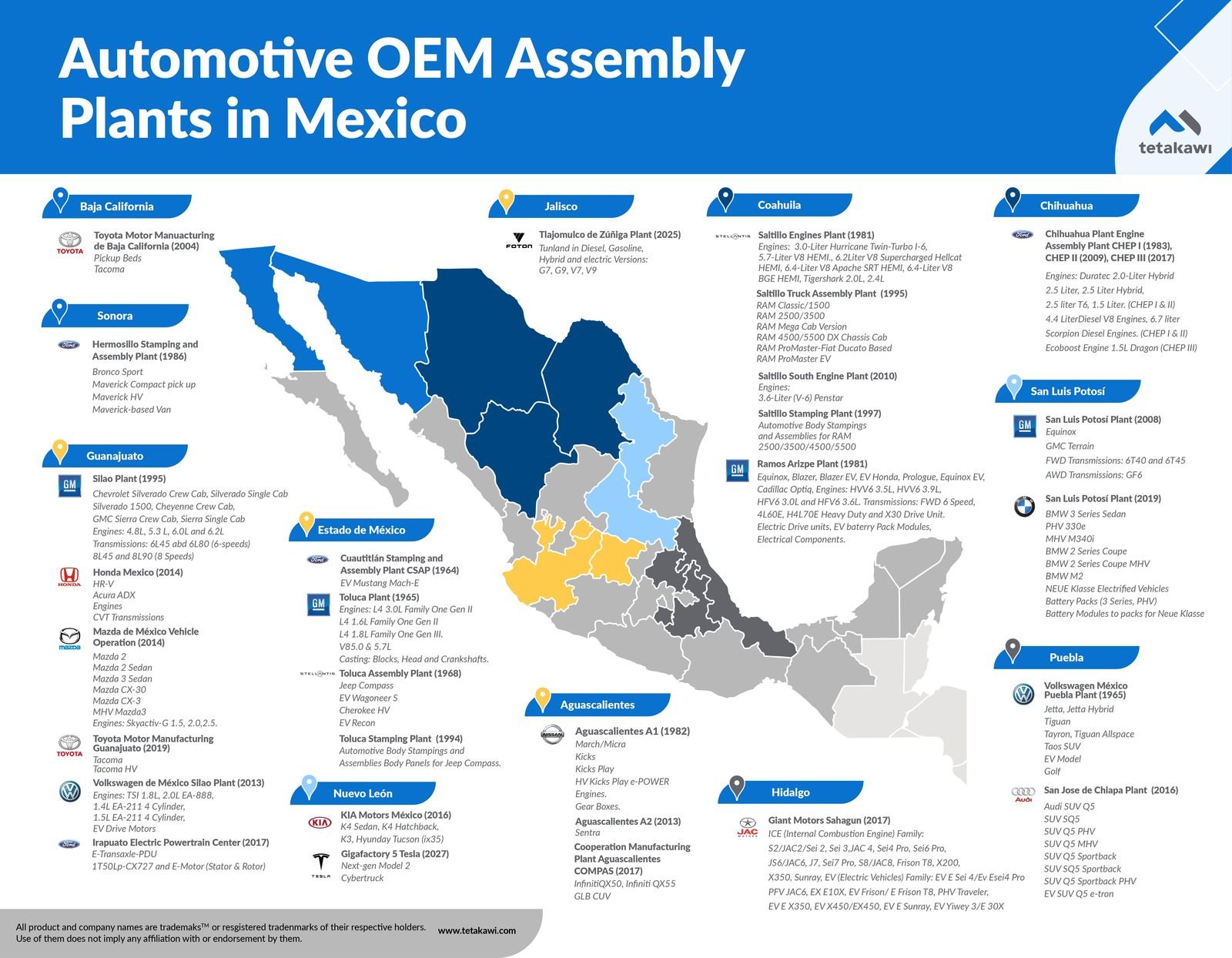
The map above is the practitioner reference for cluster-level site selection: every OEM assembly plant plotted, every cluster boundary visible.
The 2026 tariff stack — Section 232, 301, and IEEPA
Tariff disclosure (current as of ): tariff regimes shift. Verify against current customs guidance the day of any sourcing decision.
U.S. trade policy in 2025–2026 produced three layered tariff regimes that materially affect Tier 2 and Tier 3 supplier economics:
- Section 232 — 25% tariffs on imported automobiles and certain auto parts, effective April/May 2025. For USMCA-qualifying vehicles, the tariff can be applied to non-U.S. content after documentation and approval. USMCA-originating auto parts have received temporary tariff relief while Commerce establishes a content-calculation process. Maintaining USMCA qualification and documentation discipline is what keeps suppliers positioned for available relief and future content-based treatment.
- Section 301 — targeted tariffs on Chinese-origin auto parts and inputs, with rates that have shifted multiple times. Effective rate on Chinese-origin auto parts often exceeds 50% once 232 stacks.
- IEEPA orders — additional emergency-authority tariffs that have layered on top of 301 in select categories.
In an illustrative scenario for a tariff-exposed component, a $50 part produced in Mexico under USMCA-compliant content rules and trucked into the U.S. may land near $58–$62 once logistics are added (the USMCA exemption keeps Section 232 off the bill). A comparable China-origin part can land materially higher once Section 232, Section 301, and applicable IEEPA measures stack on the import. The exact outcome depends on HTS classification, content, origin, Incoterms, and current customs guidance — and on whether antidumping or countervailing duties apply. A margin gap of this magnitude is one of the practical reasons Tier 1s and OEMs are accelerating automotive manufacturing in Mexico.
For a deeper review of the tariff regime, the categories most affected, and the compliance posture suppliers should adopt, see Mexico Tariffs 2026: What Manufacturers Actually Need to Know.
The EV transition — what's at risk and what's resilient
For a Tier 2 or Tier 3 producing parts that depend on internal combustion engines, the question is no longer whether the EV transition affects them. It is which segments shrink first and which categories grow fast enough to absorb redeployed capacity. McKinsey and S&P Global Mobility both project that ICE-only categories shrink by more than 50% by 2035. The transition is asymmetric, not catastrophic, and the bridge runs through hybrid demand. North American hybrid share has climbed from 13.8% in late 2024 to 17.1% in mid-2025 as ZEV demand reset.
At Risk — ICE-only categories
- Exhaust systems
- Fuel injection and fuel tanks
- Transmissions and clutches
- Manifolds, pistons, valves
- ICE filters and spark plugs
- Traditional driveline
Resilient — categories that grow with EV
- Battery cell housings and packs
- Battery thermal management / cold plates
- E-motor laminations, magnets, windings
- Power electronics (inverters, BMS, OBC)
- High-voltage harnesses and connectors
- Lightweight structural castings (megacasting)
- Regen-brake friction parts
Mexico is where significant EV-component capital is actually landing. Stellantis committed $1.6B to Toluca for EV and hybrid production. GM allocated $1B to Saltillo for EV-prep. Hyundai Mobis is investing in an EV battery plant in Pesqueria, Nuevo Leon. Audi and BMW are running EV programs from San Luis Potosi. For Tier 2 and Tier 3 suppliers in resilient categories, the demand is materializing within a four-hour truck radius of these anchors. The next decade of automotive manufacturing in Mexico is being written by which suppliers redeploy fastest into these categories.
The practical implication: a Tier 2 making exhaust manifolds today should be cautious about entering Mexico solely to extend an ICE-only product line. The stronger move is to redeploy that stamping or casting capacity into structural battery enclosures, e-motor housings, or thermal management plates, where the same process knowledge applies and the customer pull is durable.
How a Tier 2 or Tier 3 supplier sets up in Mexico
Setup paths are well-defined. The choice between them depends mostly on capital, timeline tolerance, and whether the operating company has prior experience in Mexico.
Greenfield versus shelter
A greenfield setup means forming a Mexican legal entity, securing the IMMEX certification, hiring HR, payroll, customs, and compliance staff in country, building or leasing a facility, and managing all administration directly. Timeline: 8 to 12 months to first production. A shelter structure means producing under an existing Mexican entity that holds the IMMEX certification and runs the administrative back office. The foreign manufacturer keeps control of equipment, workforce, quality systems, and intellectual property; the shelter handles legal, tax, customs, and labor compliance. Timeline: often 30 to 90 days, depending on scope and readiness. For a $50M–$500M parts maker entering Mexico for the first time, the shelter path is structurally faster and de-risks year one. For a deeper comparison, see Advantages of a Shelter Company in Mexico.
Eight questions to answer before committing
- Does my customer's USMCA RVC math actually need my category? If your part is a USMCA core part or feeds one, OEM and Tier 1 pull is durable. If it is a non-core commodity, expect price-led competition from Asian transplants.
- Capacity gap or capability gap? Capacity gaps (stamping, basic casting) reward fast-moving operators replicating known processes. Capability gaps (silicon-carbide packaging, megacasting, battery cells) require deeper capital and a deeper engineering bench. Different risk profile, different timeline.
- Where is my customer concentration, and is the volume awarded? Bajio versus Northeast versus Northwest each have distinct labor pools, logistics profiles, and Tier 1 mixes. But site selection should follow awarded or probable platform volume, not just plant proximity. SOP/EOP timing, model mix, and customer sourcing strategy matter more than geography alone.
- What is the customer qualification timeline? Supplier localization is not a plug-in. PPAP, APQP, customer audits, run-at-rate validation, IATF 16949 readiness, and tooling transfer can add 12 to 24 months before meaningful production revenue. Plan the financial model around when revenue actually starts, not when the lease is signed.
- Is my Mexico content actually USMCA-originating? A Mexico assembly operation that uses tariff-exposed Chinese inputs (chips, magnets, cells, fasteners, electronics) may not solve the OEM's RVC, Section 301, or customer-origin problem. Strategic value depends on content traceability through the bill of materials, not just the final assembly location.
- Have I screened utilities before labor and real estate? For aluminum casting, forging, extrusion, and high-load electronics operations, power availability and CFE interconnection timing are often gating items. Water access matters for casting and surface treatment. Run a utilities-and-permitting screen before signing real estate.
- Can I staff the technical bench locally? 70% of Mexican auto parts companies report difficulty filling technical roles. Plan retention strategy before site selection.
- What is my realistic timeline to USMCA traceability? Document-of-origin, the 70% steel and aluminum rule, LVC sign-off: these compliance functions are routinely underestimated. Build the plan around 18 months of compliance maturation, not 6.
Common pitfalls (and how to avoid them)
- State permitting timelines — land-use, environmental, and water-discharge permits routinely run 6 to 12 months. First-time entrants underestimate this.
- IMMEX Annex 24 / Annex 30 reconciliation — inventory traceability failures trigger duty repayment and penalties. Software systems and process discipline matter from day one.
- Wrong union affiliation at startup — Mexico's labor reform under T-MEC and the Rapid Response Mechanism raise the cost of mis-affiliation. The decision is structural, not administrative.
- Customs broker selection — one bad agente aduanal can cost weeks at the border. Vetting is non-negotiable.
- Transfer pricing — intercompany sales of auto parts to U.S. parents must follow Article 76-A reporting. Big-4 advisory is standard.
- Maquila Safe Harbor calculation — calculation errors on assets and operating expenses trigger SAT audit exposure.
Green flags and red flags
Green flags — Mexico is the right call
- Your category is on the gap list above
- A named Tier 1 anchor is committing capex within 100 km
- Your customer has a public localization commitment
- Plan Mexico and INA-IFC PDP financing applies
Red flags — reconsider
- Category is already crowded with Asian transplants
- Your part's regional content is already 80% or higher
- High energy or water draw with unresolved CFE interconnection
- USMCA-compliant raw-material chain is more than 18 months away
Talk to an Expert
Considering Mexico for your Tier 2 or Tier 3 operation?
Tetakawi runs five Manufacturing Campuses across Sonora, Coahuila, and Sinaloa, supporting 75+ active manufacturers. Tetakawi helps manufacturers evaluate cluster fit, IMMEX setup, operating model, and USMCA compliance requirements before committing capital.
Discuss Site SelectionRelated reading: Manufacturing Labor Costs in Mexico: Executive Benchmark Guide · The IMMEX Program: 2026 Compliance Guide · Permanent Establishment in Mexico · Solving the Labor Shortage (ebook).
Frequently Asked Questions
How big is automotive manufacturing in Mexico?
Mexico produced 969,294 light vehicles in Q1 2026, the country's second-highest first quarter ever after 2019. Annual production has tracked between 3.7 and 4.2 million units in recent years. The auto parts segment closed 2025 at US$119 billion in production and US$103.5 billion in exports, making automotive manufacturing in Mexico the world's fourth-largest auto parts producer and the source of a record 46.25% of U.S. auto parts imports.
What is Plan Mexico and what does it mean for auto parts suppliers?
Plan Mexico is the Sheinbaum administration's industrial-policy framework, unveiled in January 2025. For automotive, it targets a 10% increase in domestic vehicle production by 2030, a 15% increase in local content, and 50% domestic sourcing of the supply chain. Tax depreciation incentives ranging from 41 to 91 percent in 2025–2026 are available to qualifying activities. The 50% domestic-sourcing target is read as durable demand pull for new Tier 2 and Tier 3 supplier capacity.
Where are the supply chain gaps in Mexico's auto industry?
Documented capacity shortfalls include stamping (22 OEMs/Tier 1s seeking local supply against 14 available), aluminum high-pressure casting (24 against 7), aluminum gravity die casting (15 against 3), and a near-total gap in aluminum extrusion and forging. Capability gaps include semiconductor assembly and packaging, EV battery cells, e-motor magnets, power electronics, battery thermal management, and silicon-carbide packaging. INA's Tier 2/3 chain strengthening initiative is publicly recruiting in these categories.
Where should a Tier 2 or Tier 3 supplier locate in Mexico?
Within a four-hour truck radius of the OEM or Tier 1 customer driving the volume. The Bajio (Guanajuato, Queretaro, Aguascalientes, San Luis Potosi) suits passenger-vehicle and EV programs anchored by GM, Honda, Toyota, Mazda, Nissan, and BMW. The Northeast (Saltillo, Ramos Arizpe, Monterrey) suits Stellantis and GM truck programs. The Northwest (Sonora, Chihuahua, Baja California) suits Ford and West Coast logistics, with Tijuana strong on electronics and harnesses.
What does USMCA require, and when does it get reviewed?
USMCA requires 75% Regional Value Content for passenger vehicles and light trucks, 70% North American sourcing for steel and aluminum, and 40 to 45% Labor Value Content at the $16-per-hour wage floor. The first USMCA Joint Review begins July 1, 2026. The USITC published notice of Investigation 332-608 in the Federal Register on February 23, 2026, preparing the third biennial economic-impact report on the auto rules of origin. The public hearing is October 14, 2026, prehearing briefs are due October 1, and the final report is due to Congress and the President no later than July 1, 2027. Tier 2 and Tier 3 suppliers should treat the next 18 months as a window in which compliance posture is being audited at the federal level.
Greenfield or shelter — which is the right setup for a first-time entrant?
For a $50M–$500M parts maker entering Mexico for the first time, the shelter structure is structurally faster (30 to 90 days versus 8 to 12 months for greenfield) and de-risks the first year by routing legal, tax, customs, and labor compliance through an existing Mexican entity. Greenfield is the right call when long-term scale, control of every administrative function, and ownership of a Mexican legal entity matter more than time-to-production.
Sources and Methodology
Production and trade data: AMIA (Asociacion Mexicana de la Industria Automotriz) Q1 2026 release; INA (Industria Nacional de Autopartes) 2025 close; INEGI Light Vehicle Administrative Record; OICA global production statistics.
Capacity-shortfall figures (22 stamping suppliers needed against 14 available; 24 aluminum high-pressure casting against 7; 15 gravity die casting against 3; near-total aluminum extrusion gap): drawn from INA capacity-mapping and matchmaking work, reported by Mexico Business News in “Mexico's Auto Sector Faces Tier 2 Supplier Shortfall” and “Improved Local Supply Options for Aluminum Die Casting” (2025). These are buyer/supplier availability indicators from INA matchmaking and capacity-mapping work, not a complete census of national installed capacity.
Tier 2 and Tier 3 plant expansions table: company press releases and Mexico Business News investment-tracking series (2024–Q1 2026); S&P Global AutoTechInsight investment announcements; Cluster Industrial reporting on the 2025 INA close.
Plan Mexico: Wilson Center summary; Jones Day analysis; Mexico Business News, “Sheinbaum's Plan Mexico to Drive Auto Production, Local Content” (2025).
USMCA rules of origin: USTR 2024 USMCA Autos Report to Congress; USITC Investigation 332-608; Federal Register notice (Feb 23, 2026); CSIS USMCA Review 2026; Baker Institute Strategic Priorities.
Tariff math: Section 232 (April 3, 2025 Federal Register, 25% on imported autos and parts with USMCA-content provisions); Section 301 China-origin tariffs (rates as posted by USTR); IEEPA orders (executive proclamations 2025). Landed-cost figures are illustrative tariff arithmetic; exact rates vary by HTS classification and are subject to change. Verify against current customs guidance before any sourcing decision.
EV transition: McKinsey, “Navigating the End of the ICE Age"; S&P Global Mobility EV production forecasts; WRI, “EV Transition Auto Manufacturing Jobs"; Mexico Business News, “Mexico's EV Revolution Update for 2025."
Thinking about manufacturing in Mexico? Download this ebook and start moving your due diligence forward.