By Ricardo Rascon, Director of Marketing at Tetakawi · Updated
KEY TAKEAWAY
The IMMEX program is the legal framework that allows manufacturers to temporarily import materials into Mexico duty-free for export production. As of February 2026, 5,821 active IMMEX programs support over 3.2 million workers across Mexico. The program covers five modalities, requires a separate IVA/IEPS certification for VAT benefits, and carries compliance obligations that have tightened sharply — over 600 programs were suspended in 2025 alone.
5,821
Active IMMEX Programs
3.2M+
Workers Employed
600+
Programs Suspended in 2025
16%
IVA on Imports (Separate Cert Required)
What Is the IMMEX Program?
The IMMEX program is an authorization granted by Mexico's Secretaría de Economía that allows a Mexican legal entity to temporarily import goods — raw materials, components, machinery, and equipment — to manufacture, transform, or repair products for export without paying import duties during their temporary stay. It is the foundational legal framework for export manufacturing in Mexico, and the program your operation will run on if you manufacture here.
The full name is Industria Manufacturera, Maquiladora y de Servicios de Exportación. The IMMEX Decree was published on , consolidating the older maquiladora and PITEX (temporary import) programs into a single framework. The legal foundation also includes the Customs Law (Ley Aduanera) and SAT's Foreign Trade General Rules (Reglas Generales de Comercio Exterior, or RGCE), updated annually.
The key word is temporary. IMMEX creates a customs regime where goods enter Mexico on the condition that they will be transformed and exported. Inputs get 18 months. Containers and packaging get two years. Machinery and equipment can stay for the duration of the program. If goods are not exported or otherwise lawfully discharged within those windows, you owe duties and taxes on them retroactively.
As of February 2026, 5,821 active IMMEX programs are registered with Mexico's Secretaría de Economía (SE/SNICE), collectively supporting over 3.2 million workers and generating more than 720 billion pesos in monthly revenue (INEGI, monthly IMMEX survey). Nearly 60% of IMMEX operations are concentrated along the U.S.–Mexico border zone. This is not a niche program — it is the backbone of Mexico's export manufacturing sector, supporting industries from automotive and aerospace to electronics, medical devices, and consumer goods.
The Five IMMEX Modalities
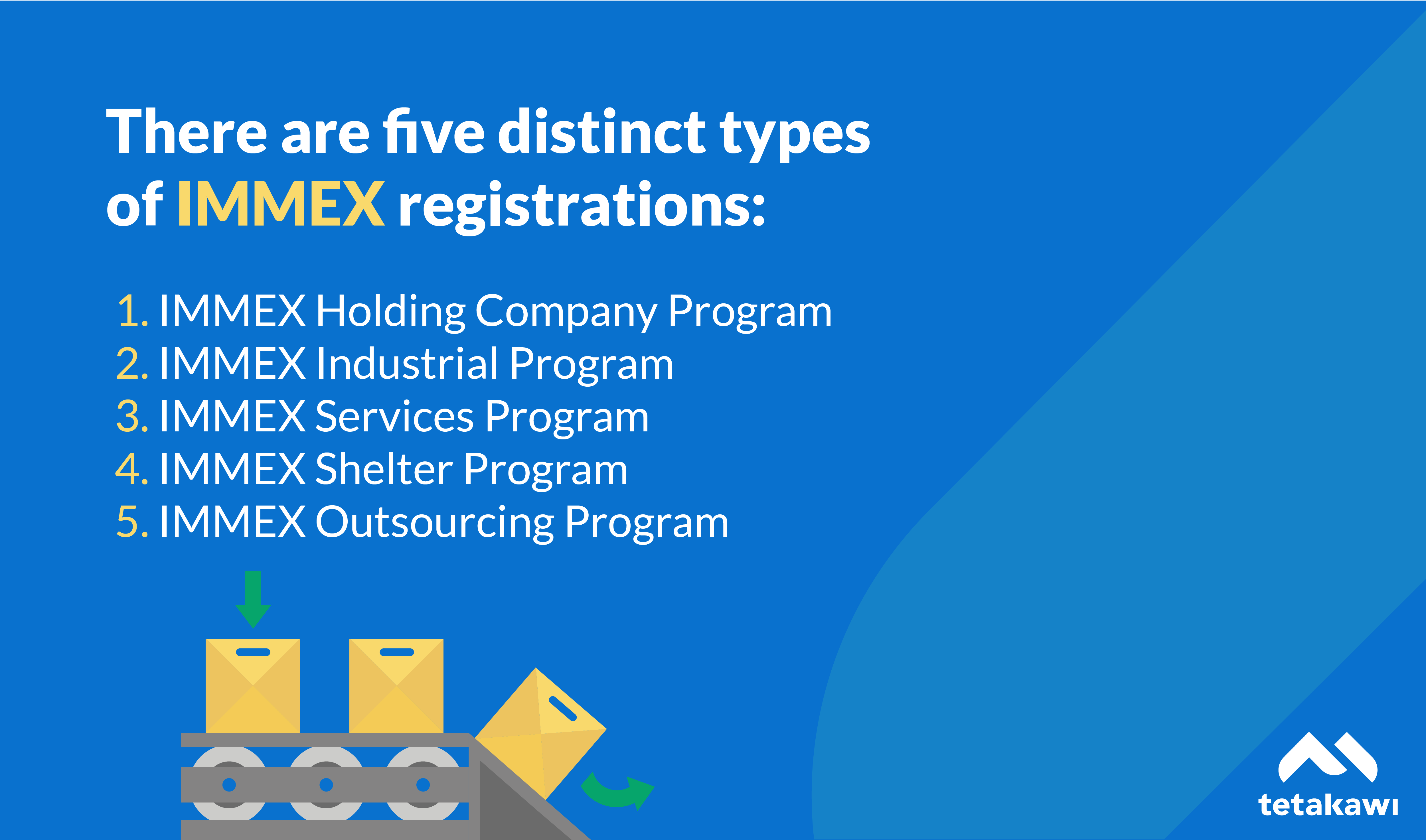
The IMMEX Decree authorizes five distinct modalities, and the one your operation falls under determines your compliance obligations, operational structure, and in some cases your tax exposure. Most foreign manufacturers entering Mexico through a shelter provider operate under the Shelter (Albergue) modality.
1. Industrial
The classic maquiladora use case. A Mexican legal entity imports raw materials and components temporarily, transforms them into finished products, and exports. Automotive, electronics, medical devices, aerospace — the majority of IMMEX operations fall under this modality. Requirements include a detailed description of your manufacturing process, installed production capacity, and the tariff classifications of both what you import and what you export.
2. Services (Servicios)
For companies that temporarily import goods to provide export-related services rather than manufacturing physical products — repair, maintenance, remanufacturing, testing, and certain software or logistics services. Your specific service activity must be on the Secretaría de Economía's authorized list. Not every service qualifies, and this is where companies get tripped up: assuming they qualify when their activity does not match what SE has approved.
3. Shelter (Albergue)
A Mexican company holds the IMMEX program and hosts a foreign entity, allowing the foreign manufacturer to operate in Mexico without establishing its own Mexican legal entity. The shelter company assumes program compliance obligations for imports and exports. This is the fastest path to operational launch and the modality most directly relevant to how companies start manufacturing in Mexico through a shelter service provider, where the compliance infrastructure — customs brokerage, import/export documentation, Annex 24 inventory systems — is already built and actively managed.
The tradeoff: you are relying on the shelter's controls. Contract structure matters significantly, particularly around permanent establishment risk, IP protection, and labor liability. These are the specific items your legal and tax advisors should examine before you sign.
4. Holding Company (Controladora de Empresas)
A certified parent company integrates the manufacturing operations of one or more subsidiaries under a single IMMEX program and handles consolidated exports. Used by corporate groups that want centralized control over temporary imports, compliance reporting, and customs operations across multiple entities or facilities.
5. Third-Party Manufacturing (Terciarización)
When a certified IMMEX company does not own the production facilities, it can carry out manufacturing through a registered third party. The third party must be explicitly registered in the IMMEX program, and both parties accept joint liability for the temporarily imported goods. This is not staffing outsourcing — it refers specifically to where the physical manufacturing process occurs. Given the enforcement climate in 2025–2026, this modality receives heightened scrutiny from authorities.
What You Can Import Under IMMEX
The IMMEX Decree authorizes temporary import of three categories of goods, each with different time limits defined in Article 4. These deadlines are enforced — miss one, and you owe duties and taxes retroactively.
| Category | What It Includes | Time Limit |
|---|---|---|
| Inputs (Frac. I) | Raw materials, parts, components, containers, packaging, labels, manuals | Up to 18 months |
| Containers & Tools (Frac. II) | Containers, molds, dies, instruments, quality and safety control tools | Up to 2 years |
| Machinery & Equipment (Frac. III) | Production machinery, telecom/IT, R&D, environmental, and operational equipment | Duration of the IMMEX program |
These time limits make inventory control the heartbeat of IMMEX compliance. Every temporarily imported item must be tracked from entry through transformation to export or discharge. The updated Annex 24 requirements (effective ) now require system updates within 48 hours of customs formalities — a shift from periodic to near-real-time tracking.
What IMMEX Gets You — and What It Does Not
The IMMEX program provides a legal framework for duty-free temporary imports, but many published guides overstate its benefits or conflate IMMEX with separate certifications. Here is what is actually true.
What IMMEX Provides
- Temporary import framework
- IMMEX is the legal container that lets you run a flow-through manufacturing model: goods enter Mexico temporarily, are transformed, and are exported. Without it, you are importing definitively and paying everything upfront.
- Duty deferral on temporary imports
- You do not pay import duties (IGI) on goods that enter temporarily under the IMMEX program, as long as they are exported or discharged within the allowed timeframe.
- Operational facilitations
- The decree includes provisions for handling waste and scrap (desperdicios), rectifying customs data, reducing fines for voluntary compliance, and transferring temporarily imported goods between IMMEX companies for submanufacturing.
- Automatic importer registry
- Once SE authorizes your IMMEX program, it triggers electronic transmission of your data to SAT for enrollment in the importer registry (padrón de importadores), streamlining what is otherwise a separate process.
What IMMEX Does Not Provide
CRITICAL DISTINCTION
IMMEX alone does not eliminate your VAT obligation on temporary imports. Mexico charges 16% IVA on temporary imports. The mechanism that provides a 100% tax credit — effectively allowing you to avoid paying VAT cash upfront — is a separate SAT certification called the Registro en el Esquema de Certificación de Empresas, modalidad IVA e IEPS. You must apply for it after obtaining your IMMEX, and it has its own requirements, compliance obligations, and renewal cycles. Companies that assume IMMEX equals no VAT find out the hard way on their first import cycle.
The VAT Certification: What Comes After IMMEX
The IVA/IEPS Certification is the SAT certification that provides a 100% tax credit on VAT and IEPS for qualifying temporary imports under the IMMEX program. Think of IMMEX as the base license — the real financial optimization comes from stacking this certification on top of it.
What Is the IVA/IEPS Certification?
Formally the Registro en el Esquema de Certificación de Empresas, modalidad IVA e IEPS, this is a SAT certification handled by AGACE. Through the legal mechanism in Ley del IVA article 28-A and Ley del IEPS article 15-A, it provides a 100% tax credit for VAT and IEPS on qualifying temporary imports. Your temporary imports clear customs on a cashless basis for VAT purposes.
Three Certification Levels (Rubros)
| Requirement | Rubro A | Rubro AA | Rubro AAA |
|---|---|---|---|
| Operational history | 12+ months | 4+ years | 7+ years |
| OR IMSS workers | 10+ | 1,000+ avg | 5,500+ avg |
| OR machinery value | — | $50M+ MXN | $100M+ MXN |
| VAT refund timeline | 20 business days | 15 business days | 10 business days |
| Renewal cycle | Annual | Annual | Annual |
An important change from late 2023: all three rubros now require annual renewal. Previously, Rubro AA was valid for two years and AAA for three. The Fourth Resolution of Modifications to the RGCE for 2023 eliminated those extended periods by repealing fraction I of rule 7.1.6. Companies with existing multi-year authorizations before retained their original validity period until expiration.
The Practical Sequence
The progression most companies follow:
- Obtain IMMEX — the temporary import authorization from Secretaría de Economía
- Apply for IVA/IEPS Certification — the SAT certification providing the VAT/IEPS credit (start with Rubro A, upgrade later)
- Pursue OEA certification (optional) — the SECIIT rubro, most relevant for IMMEX manufacturers, requires an active IMMEX program plus IVA/IEPS certification at the AA or AAA level
- Add PROSEC (where applicable) — preferential import duty rates on inputs for specific industrial sectors (a tariff tool, not a VAT tool)
Under a shelter arrangement, this entire stack is managed by the shelter company's logistics and compliance teams. The foreign manufacturer operates under the shelter's IMMEX program and benefits from its existing certifications — including the IVA/IEPS certification that most new entrants would otherwise spend months obtaining independently.
How to Obtain an IMMEX Program
The IMMEX application process runs through VUCEM, Mexico's single-window trade portal. The statutory timeline is 15 business days for SE to issue a resolution, with affirmative ficta mechanics if they do not respond.
Eligibility Requirements
You must be a Mexican legal entity (persona moral) with a favorable SAT compliance opinion, an active RFC, an e.firma (advanced electronic signature), and registered tax and operating addresses. You cannot be on SAT's lists of simulated transactions (articles 69 and 69-B of the Fiscal Code).
Required Documentation
- General company information: shareholders, legal representative, corporate structure
- Detailed description of your manufacturing process and installed production capacity
- Tariff classifications for goods you will import and export
- Sector classification
- Export commitment: more than $500,000 USD in annual exports, or exports representing at least 10% of total annual revenue
- Facility documentation: articles of incorporation, proof of legal possession with photos, export contracts or purchase orders, investment program with layouts, headcount, and estimated import volumes
Site Inspection
Expect an inspection visit by SE (sometimes jointly with SAT) before approval. They verify installed production capacity. If you only have the building and not the machinery yet, SE may issue a pre-operative authorization for three months, during which you can only import certain goods. A second inspection verifies equipment installation.
The Shelter Alternative
Under the shelter modality, the shelter company already holds an active IMMEX program with established certifications. A foreign manufacturer begins operations under the shelter's IMMEX without going through the full application process independently. The shelter manages inventory systems, customs brokerage, and regulatory filings that would otherwise take months to build from scratch.
This is meaningful time compression. A standalone IMMEX application can take several months end to end (entity formation, RFC, e.firma, application, inspection, program activation). Through a shelter with existing Manufacturing Campus facilities, the operational timeline from contract to production can be 30 to 60 days.
Keeping Your IMMEX Program: Compliance That Matters
Getting the IMMEX authorization is the beginning, not the finish line. The program carries ongoing obligations that, if missed, result in suspension or cancellation. With over 600 programs suspended in 2025 alone, these are not theoretical risks.
Annual Report (RAOCE)
Every IMMEX holder must file an electronic annual report of total sales and exports for the prior fiscal year, due by the last business day of May. Miss the deadline and your ability to import temporarily is suspended. If you do not cure the suspension by the last business day of August, your IMMEX program is cancelled effective .
Export Threshold
You committed to exporting more than $500,000 USD annually or at least 10% of total revenue. Failing to meet this threshold can trigger suspension and cancellation proceedings.
Annex 24 Inventory Control
This is where the compliance burden has increased most significantly. The IMMEX Decree requires an automated inventory control system that tracks every temporarily imported item through its lifecycle. The 2026 Annex 24 text, published in the DOF, requires inventory systems to be updated within 48 hours of customs formalities, AGACE to be granted online access including user credentials and system manuals, and records to withstand real-time electronic audit.
For a deeper look at how Annex 24 works and what the updated requirements mean operationally, we cover that in a separate guide. The shift from periodic audit preparation to continuous monitoring is material — companies that previously updated inventory records weekly or monthly must now operate in near-real-time.
What Happens if Your IMMEX Is Cancelled
If SE cancels your program, you have 60 calendar days to either convert all temporarily imported goods to definitive import regime (paying all applicable duties and taxes) or return them. A one-time extension up to 180 calendar days may be authorized by SAT, but do not count on it.
What Changed in 2025–2026
The compliance environment around the IMMEX program has tightened considerably. These are documented enforcement actions and regulatory changes that every manufacturer operating in Mexico needs to track.
Mass Program Suspensions
In 2025, more than 600 IMMEX programs were suspended — per SE enforcement notices — due to operational inconsistencies, documentary non-compliance, or insufficient controls. The Secretaría de Economía has cancelled dozens of registrations, with new 2026 trade rules requiring companies to be listed under specific annexes and legal decrees to maintain eligibility.
Tariff Reform ()
On , Mexico published a decree increasing import duty rates (IGI) on approximately 1,500 tariff codes — roughly 12% of the tariff schedule. Sectors affected include cosmetics, plastics, leather, textiles, apparel, footwear, steel, aluminum, automotive, auto parts, and toys. These increases took effect . IMMEX temporary imports are generally not subject to IGI, but higher baseline rates increase the financial risk if goods fail to qualify as temporary imports or if IMMEX status is lost. For context on broader tariff dynamics, see our analysis of the USMCA 2026 review.
Sensitive Goods Restrictions
Textile and apparel products now face additional restrictions for temporary import under the IMMEX program. Companies with IVA/IEPS certification importing sensitive goods may need to process quarterly program extensions, and the export percentage threshold for sensitive goods under VAT certification has increased under recent RGCE modifications.
Criminal Liability Expansion
Under recent fiscal and trade enforcement reforms, certain irregularities in foreign trade operations — incorrect customs valuation, inventory inconsistencies, improper use of tax benefits, Annex 24 failures, or invalid tax documentation — may now fall within the scope of criminal liability. What used to be administrative penalties can escalate into criminal investigations. This is the development that warrants attention at the executive level.
IMMEX 4.0 and Digital Transformation
As part of Mexico's "Plan Mexico," the government has signaled plans to modernize the IMMEX program through automation and digital transformation. Stated goals include faster authorization processing and enhanced sector oversight. The practical implication: expect increasingly automated compliance monitoring based on Annex 24 data. The era of preparing for audits after notification is giving way to continuous electronic oversight.
How IMMEX Works Under a Shelter Arrangement
The compliance stack described above — IMMEX authorization, IVA/IEPS certification, Annex 24 inventory systems, annual filings, inspection readiness, regulatory tracking — is not trivial to build or maintain. For companies exploring manufacturing in Mexico, this is one of the structural arguments for the shelter modality.
Under a shelter, the IMMEX program and its associated certifications are held by the shelter company. The foreign manufacturer operates within that compliance framework. In a Manufacturing Campus model, this goes further: logistics, customs brokerage, regulatory compliance, workforce management, and facility operations are consolidated under a single operational partner.
What that means in practice for IMMEX specifically:
- The shelter manages Annex 24 compliance across all campus operations — the 48-hour update requirement, AGACE online access, inventory lifecycle tracking
- Import/export documentation, customs brokerage, and pedimento processing are handled by the shelter's dedicated trade compliance team
- Annual filings (RAOCE, DIEMSE), export threshold monitoring, and regulatory change tracking are operational responsibilities of the shelter
- IVA/IEPS certification renewal — now annual for all rubros — is handled through the shelter's existing SAT relationship
This is not about removing responsibility. The foreign manufacturer is still accountable for its production operation. But the regulatory infrastructure — the part requiring specialized customs expertise, continuous SAT engagement, and deep familiarity with Mexico's evolving trade rules — is managed by teams that do this across dozens of operations simultaneously.
Need Clarity on How IMMEX Applies to Your Operation?
Which modality fits, what the real timeline looks like, and how the compliance stack works in practice — that is a conversation we have with manufacturers regularly.
Talk to Our TeamRelated reading: The Complete Guide to Shelter Services in Mexico · The USMCA 2026 Review · Solving the Manufacturing Labor Shortage in Mexico
This article provides general business information about Mexico's IMMEX program and does not constitute legal, tax, or customs advice. Regulatory requirements change frequently. Consult qualified trade compliance, legal, and tax advisors for guidance specific to your operation.
LISTEN
Podcast: What Is Mexico's IMMEX Program? (FAQ Edition)
Hear the most common IMMEX questions answered by the Tetakawi team — covering modalities, VAT certification, compliance, and the shelter path.
Frequently Asked Questions
What does IMMEX stand for?
IMMEX stands for Industria Manufacturera, Maquiladora y de Servicios de Exportación (Manufacturing, Maquiladora and Export Services Industry). It is an authorization from Mexico's Secretaría de Economía that allows Mexican legal entities to temporarily import goods for manufacturing, transformation, repair, or export services without paying import duties during the temporary stay period.
What are the main benefits of the IMMEX program?
The IMMEX program provides duty-free temporary imports, operational facilitations for manufacturing, streamlined importer registry enrollment, and the legal framework for flow-through export manufacturing. However, IMMEX alone does not eliminate VAT obligations. The 100% VAT/IEPS tax credit requires a separate SAT certification (IVA/IEPS Certification under Ley del IVA article 28-A), which companies must apply for after obtaining IMMEX.
How do I register for IMMEX?
Applications are submitted through VUCEM to the Secretaría de Economía. You need a Mexican legal entity with active RFC, e.firma, a favorable SAT compliance opinion, and an export commitment of $500,000+ USD annually or exports representing 10%+ of total revenue. SE has 15 business days to issue a resolution. Expect a site inspection before approval. Alternatively, through a shelter company, you can operate under an existing IMMEX program without the standalone application process.
What is the difference between IMMEX and the maquiladora program?
IMMEX replaced the older maquiladora and PITEX programs in 2006, consolidating them into a single decree. The original maquiladora program (created in the 1960s) addressed only maquiladora operations. IMMEX expanded the framework to cover manufacturing, services, and multiple operational modalities including Industrial, Services, Shelter, Holding Company, and Third-Party. While "maquiladora" and "IMMEX" are sometimes used interchangeably in conversation, IMMEX is the current legal instrument.
What happens if my IMMEX registration is cancelled?
If the Secretaría de Economía cancels your IMMEX, you have 60 calendar days to either convert all temporarily imported goods to definitive import regime (paying full duties and taxes) or return them to their country of origin. SAT may authorize a one-time extension up to 180 calendar days. Common causes include failing to file the annual report (RAOCE) by the August deadline, not meeting export thresholds, Annex 24 inventory control failures, and operational inconsistencies found during inspections.
How does a shelter company handle IMMEX compliance?
Under the shelter (albergue) modality, the shelter company holds the IMMEX program and its associated certifications, including IVA/IEPS certification. The shelter manages Annex 24 inventory control, customs brokerage, import/export documentation, annual regulatory filings, and SAT certification renewals. The foreign manufacturer operates within this compliance framework, allowing it to begin production without building the regulatory infrastructure independently. In a Manufacturing Campus model, these compliance functions are integrated with workforce management, facility operations, and logistics under a single operational partner.
Thinking about manufacturing in Mexico? Download this ebook and start moving your due diligence forward.