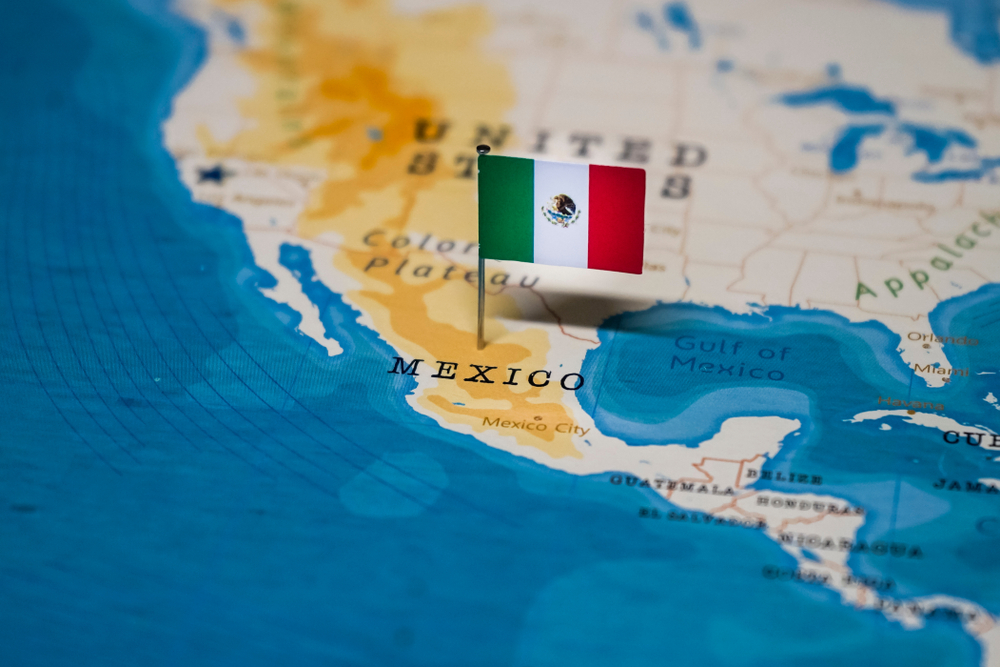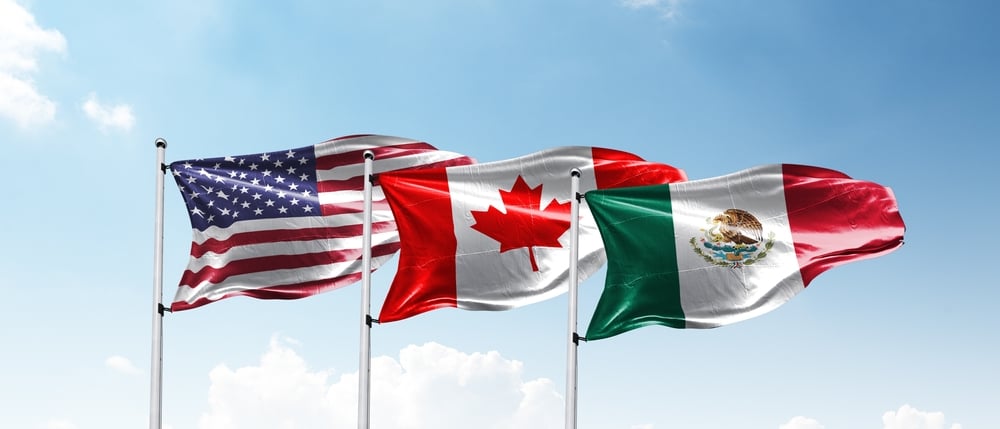
Mexico's 14 free trade agreements cover 52 countries and roughly 60% of global GDP — more preferential trade access than the United States, China, or India can offer from any single production base. For manufacturers, this network means a factory in Mexico can ship duty-free to markets across North America, Europe, Asia-Pacific, and Latin America. Explore the full network with Tetakawi's interactive FTA map.
Mexico's Trade Advantage at a Glance
Mexico is the most trade-connected major manufacturing destination in the world. While the USMCA dominates headlines, the real story is what lies beyond North America. A factory in Saltillo can ship automotive components duty-free to Detroit, electronics assemblies to Frankfurt, and medical devices to Tokyo — all under preferential tariff terms that a plant in Shenzhen or Chennai cannot access. (For context on what makes Mexico competitive beyond trade access, see the complete guide to manufacturing in Mexico.) Mexico's Secretaría de Economía maintains the official registry of all active agreements.
Explore Mexico's FTA Network — Interactive Map
See the data behind all 14 agreements. Tetakawi's interactive FTA map lets you explore trade volumes, compare Mexico's coverage against the U.S., China, and Canada, and drill into country-level detail.
All 14 Free Trade Agreements: Trade Volume and Coverage
| Agreement | Partners | Countries | Coverage | In Force | 2024 Trade Volume |
|---|---|---|---|---|---|
| USMCA | US, Canada | 2 | Goods & Services | Jul 2020 | $806.1B |
| CPTPP | 11 member nations | 11 | Goods & Services | Dec 2018 | $103.4B |
| EU-Mexico | EU-27 | 27 | Goods & Services | Jul 2000 | $90.7B |
| Japan-Mexico EPA | Japan | 1 | Goods & Services | Apr 2005 | $23.6B |
| Central America | 5 nations | 5 | Goods & Services | Sep 2012 | $13.1B |
| Pacific Alliance | Chile, Colombia, Peru | 3 | Goods & Services | May 2016 | $11.4B |
| UK-Mexico TCA | United Kingdom | 1 | Goods & Services | Jun 2021 | $5.9B |
| Colombia | Colombia | 1 | Goods & Services | Jan 1995 | $5.2B |
| EFTA | 4 nations | 4 | Goods & Services | Jul 2001 | $4.8B |
| Chile | Chile | 1 | Goods & Services | Aug 1999 | $3.5B |
| Peru | Peru | 1 | Goods & Services | Feb 2012 | $2.6B |
| Israel | Israel | 1 | Goods | Jul 2000 | $1.4B |
| Panama | Panama | 1 | Goods & Services | Jul 2015 | $1.2B |
| Uruguay | Uruguay | 1 | Goods & Services | Jul 2004 | $703M |
Want to explore each agreement in detail? The interactive FTA map includes dedicated pages for all 14 agreements with sector breakdowns and partner-country profiles.
USMCA: The Anchor of Mexico's Trade Network
The United States-Mexico-Canada Agreement (USMCA) is the largest free trade agreement by trade volume, with $806.1 billion in bilateral trade in 2024. Mexico became the largest U.S. trading partner in 2023 and maintained that position through 2024. The USMCA replaced NAFTA on July 1, 2020, and introduced stricter rules of origin, labor value content requirements, and digital trade provisions.
For automotive manufacturing, the USMCA requires 75% regional value content for most passenger vehicles, meaning three-quarters of the vehicle's value must come from North America. Labor provisions now mandate a percentage of work on covered goods be performed by workers earning at least $16 per hour, a requirement that actually strengthens Mexico's competitive position against automation.
Key 2026 Development: The mandatory joint review is scheduled for July 1, 2026. The three countries must agree to extend the agreement for 16 more years, approve revisions, or trigger a 10-year sunset countdown. For manufacturers, a breakup of USMCA would be catastrophic — most supply chains are built on duty-free North American trade. This makes the 2026 review a critical inflection point.
Tetakawi operates across 60+ active manufacturers in Mexico. Approximately 85% of what current clients export qualifies for duty-free USMCA treatment. The remaining 15% either ships to non-USMCA markets or faces tariffs due to rules-of-origin complexity, not lack of preferential access.
Section 122 Surcharge Context: Since February 2026, a 10% Section 122 surcharge applies to Mexican imports, but USMCA-qualifying goods remain duty-free at the base rate. The surcharge has a 150-day statutory limit and does not override USMCA benefits.
Read the full analysis: The USMCA 2026 Review: What Manufacturers Actually Need to Prepare For
CPTPP: Mexico's Gateway to Asia-Pacific
The Comprehensive and Progressive Agreement for Trans-Pacific Partnership (CPTPP) connects Mexico to 11 member nations: Australia, Brunei, Canada, Chile, Japan, Malaysia, Mexico, New Zealand, Peru, Singapore, and Vietnam. Together, these economies represent over 500 million consumers and 13.5% of global GDP. Trade volume under CPTPP reached $103.4 billion in 2024, making it the second-largest of Mexico's FTA network.
The agreement eliminates tariffs on 89% of tariff lines immediately, with the remainder phased to zero over time. For manufacturers, CPTPP membership opens duty-free access to some of the world's fastest-growing economies. Japan alone imports $23.6 billion from Mexico annually under the Japan-Mexico EPA, which overlaps with CPTPP coverage.
UK Accession: The United Kingdom applied for CPTPP accession in 2021. Mexico formally approved the UK's accession protocol on January 20, 2026 (published by the Mexican government), but has not yet ratified. Until Mexico and other member countries complete ratification, UK-Mexico trade operates under the separate Trade Continuity Agreement ($5.9 billion in 2024 volume). Once ratified, the UK will have the same preferential access as other CPTPP members.
EU-Mexico Trade Agreement
Mexico's trade relationship with the European Union is one of the oldest and deepest. The original EU-Mexico FTA has been in force since July 2000 and covers all 27 EU member states, with $90.7 billion in bilateral trade volume in 2024. Under this agreement, 99% of products are traded duty-free. This makes the EU the second-largest FTA trading partner after USMCA.
Modernized Global Agreement (MGA): Negotiations for a comprehensive update concluded on January 24, 2025, and the European Commission adopted signing proposals in September 2025. The MGA expands agricultural market access, adds digital trade and e-commerce chapters, strengthens intellectual property protections, includes raw materials cooperation, and modernizes investment rules. An Interim Trade Agreement (iTA) is expected to enter force provisionally while full ratification proceeds. Mexico and the EU are expected to sign the MGA at a ceremony in 2026, making this one of the most significant trade developments for manufacturers serving European customers.
For sectors like automotive, aerospace, and pharmaceuticals, EU-Mexico trade is growing precisely because Mexico offers duty-free access to both North America (USMCA) and Europe (EU-Mexico). A plant in Mexico can serve three major markets with zero tariffs — an advantage neither Asia nor Eastern Europe can match.
Japan-Mexico Economic Partnership Agreement
Japan is Mexico's 4th-largest trading partner outside of North America, with $23.6 billion in bilateral trade under the Japan-Mexico Economic Partnership Agreement (EPA). In force since April 2005, the agreement covers goods and services, and has been critical for Japanese automotive and electronics manufacturers establishing Mexican supply chains.
Japanese companies like Toyota, Honda, Nissan, and Panasonic have built major operations in Mexico partly because of duty-free EPA access to both the U.S. and Japanese markets. The EPA eliminates tariffs on 99% of industrial goods and covers 94% of agricultural imports.
UK-Mexico Trade Continuity Agreement
When the UK withdrew from the EU, Mexico negotiated a Trade Continuity Agreement (TCA) to preserve duty-free access. In force since June 2021, the UK-Mexico TCA generated $5.9 billion in bilateral trade in 2024 and covers goods and services, including sectors like aerospace, automotive, financial services, and food processing. British manufacturers including Unilever, AstraZeneca, and Rolls-Royce benefit from approximately $79 million in annual duty savings under the agreement. Without the TCA, vehicle exports to the UK would face 20% WTO tariffs.
The TCA is a holding agreement. Its long-term future lies in UK CPTPP accession, which will deepen integration and align UK-Mexico trade with the broader Asia-Pacific network. Mexico's approval of UK accession on January 20, 2026 signals support for this path.
EFTA, Central America, Pacific Alliance, and Bilateral FTAs
Beyond the major agreements, Mexico maintains a network of bilateral and regional FTAs that extend duty-free access to smaller but strategic markets.
EFTA (European Free Trade Association)
Switzerland, Norway, Iceland, and Liechtenstein ($4.8 billion in 2024 trade). In force since July 2001, EFTA covers goods and services — including financial services and telecom — and is particularly important for precision manufacturing and pharma. Switzerland dominates within the EFTA group.
Central America Free Trade Agreement
Costa Rica, El Salvador, Guatemala, Honduras, and Nicaragua ($13.1 billion). In force since September 2012, this agreement consolidated separate bilateral agreements into a single framework providing access to the Northern Triangle and broader Central American supply chains.
Pacific Alliance Trade Agreement
Chile, Colombia, and Peru ($11.4 billion). In force since May 2016, the Pacific Alliance represents 225 million consumers and ranks as the eighth-largest export force globally. It eliminated 90%+ of tariffs on goods and services and includes investment protections, regulatory harmonization, and labor provisions.
Mexico-Colombia Free Trade Agreement
One of Mexico's longest-standing agreements, dating to 1994 with $5.2 billion in 2024 trade. Covers market access, rules of origin, government procurement, intellectual property, investment, and dispute resolution.
Mexico-Israel Free Trade Agreement
Mexico's only FTA with a Middle Eastern nation ($1.4 billion in 2024 trade). In force since July 2000, bilateral trade has increased over 300% since the agreement took effect. Collaboration spans communications, agriculture, infrastructure, and technology. Covers goods only.
Mexico-Panama Free Trade Agreement
In force since July 2015 with $1.2 billion in 2024 trade, covering approximately 4,000 tariff lines. Includes market access, rules of origin, intellectual property, e-commerce, financial services, and investment provisions.
Chile, Peru, and Uruguay Bilateral FTAs
Mexico also maintains separate bilateral FTAs with Chile ($3.5B, Mexico's first FTA, signed 1998), Peru ($2.6B, covering 12,017 products with phased tariff elimination), and Uruguay ($703M, with 2019 and 2020 amendments updating food tariffs and cross-border services).
Countries with Free Trade Agreements with Mexico — Complete List
Mexico has preferential trade relationships with 52 countries across six continents. The OAS SICE treaty database maintains a comprehensive reference of all texts. Here's the complete breakdown by region:
North America
United States, Canada
Europe
Austria, Belgium, Bulgaria, Croatia, Cyprus, Czech Republic, Denmark, Estonia, Finland, France, Germany, Greece, Hungary, Iceland, Ireland, Italy, Latvia, Liechtenstein, Lithuania, Luxembourg, Malta, Netherlands, Norway, Poland, Portugal, Romania, Slovakia, Slovenia, Spain, Sweden, Switzerland, United Kingdom
Asia-Pacific
Australia, Brunei, Japan, Malaysia, New Zealand, Singapore, Vietnam
Latin America
Chile, Colombia, Costa Rica, El Salvador, Guatemala, Honduras, Nicaragua, Panama, Peru, Uruguay
Middle East
Israel
Total: 52 countries across five regions.
How Mexico's Trade Access Compares
| Country/Region | Number of FTAs | Number of Countries | Key Advantage |
|---|---|---|---|
| Mexico | 14 | 52 | Only major base with preferential access to US AND EU |
| United States | 14 | 20 | Domestic market size, but limited FTA coverage |
| China | 23 | 29 | Volume, but no US or EU FTA access |
| Canada | 15 | 51 | Similar to Mexico but higher labor costs |
| India | 13 | ~20 | Labor cost, but no US or EU FTA access |
| Vietnam | 12 | ~16 | Lower labor costs, but limited major-market access |
Preferential access to both the U.S. and EU. 1-3 day transit to U.S. by truck.
Zero FTA access to U.S. or EU. 25-35 day transit to U.S. by sea.
The critical differentiator: Mexico is the only major manufacturing base with preferential tariff access to both the United States and the European Union simultaneously. India's FTA network similarly excludes North America and Europe. Vietnam has neither a US nor EU FTA.
Logistics compound the advantage. Mexico-to-US transit is 1-3 days by truck. Mexico-to-Europe is 12-18 days by ocean. Compare that to China-to-US (25-35 days), China-to-Europe (28-35 days), India-to-US (30-40 days), and Vietnam-to-US (25-35 days). That transit time difference alone cuts inventory carrying costs by roughly 50% compared to trans-Pacific sourcing.
2026 Trade Defense: Mexico is actively defending its FTA value proposition against non-FTA competitors. In 2026, Mexico imposed tariffs of up to 35-50% on more than 1,400 products from non-FTA countries, primarily targeting Chinese imports. Finished vehicles from non-FTA sources face 50% tariffs. This policy reinforces Mexico's structural advantage for manufacturers inside the FTA network.
What Mexico's FTA Network Means for Your Operation
For a VP of Operations running a total-landed-cost model, Mexico's FTA network changes the math in four ways.
First, duty-free access to your largest customer markets. If your products move to North America, Europe, or Asia-Pacific, Mexico gets you there under preferential tariff terms. A 10% tariff avoided on a $100,000 order is $10,000 in direct margin. Scale that to millions of units, and FTA savings become a material P&L driver — a key factor in the total cost of manufacturing in Mexico.
Second, supply chain flexibility across 52 countries. Your raw materials, components, and subassemblies can come from any FTA partner country and still qualify for Mexican-origin status under most agreements. This lets you source strategically — buying specialty inputs from Japan or Germany, commodity inputs from Central America, and finishing work in Mexico — all while maintaining duty-free qualification.
Third, risk diversification. If one export market faces disruption — tariff spikes, recession, supply-chain shocks — you have preferential access to 51 others. A plant in Shenzhen is exposed to one market: wherever goods can get through China's regulatory environment. A plant in Mexico is exposed to three: North America, Europe, and Asia-Pacific, with preferential terms to each. This is one reason companies are nearshoring to Mexico at accelerating rates.
Fourth, dual-market access. Mexico's GDP exceeds $1.8 trillion with a population of over 130 million. Manufacturers serve FTA partner countries and the Mexican domestic market from a single production base — a combination that improves capacity utilization and reduces per-unit costs.
Tetakawi operates 60+ active manufacturers across five Manufacturing Campuses in Mexico. Approximately 85% of client exports qualify for duty-free USMCA treatment. The remaining 15% either ships to non-USMCA markets or faces tariffs due to rules-of-origin complexity, not because of a lack of preferential access. Through its shelter services model, Tetakawi conducts a pre-operation customs analysis to map out FTA qualification for your specific products. This clarity is essential for total-landed-cost decisions.
If you're evaluating Mexico, start with the data. Explore the interactive FTA map to see what these agreements mean for your specific industry and markets.
Put Mexico's Trade Network to Work
Explore trade volumes, compare agreements, and see how Mexico's 52 FTA partners stack up against the competition.
Explore the Interactive FTA Map →Related Reading
- The USMCA 2026 Review: What Manufacturers Actually Need to Prepare For — Read the analysis →
- Mexico Tariffs 2026: What Manufacturers Actually Need to Know — Read the guide →
- 10 Products Made in Mexico That May Surprise You — Read the guide →
- Solving the Labor Shortage: A Guide for Manufacturers — Download the ebook →
Frequently Asked Questions
How many free trade agreements does Mexico have?
Mexico has 14 active free trade agreements covering 52 countries across six continents. These agreements provide preferential tariff access to roughly 60% of global GDP. The largest by trade volume is the USMCA ($806.1 billion in 2024 bilateral trade), followed by the CPTPP ($103.4 billion) and the EU-Mexico agreement ($90.7 billion).
Which countries are involved in the USMCA?
The USMCA (United States-Mexico-Canada Agreement) involves three countries: the United States, Mexico, and Canada. It replaced NAFTA on July 1, 2020 and generated $806.1 billion in bilateral trade in 2024. A mandatory joint review is scheduled for July 1, 2026, when the three countries must agree to extend the agreement for 16 more years, approve revisions, or trigger a 10-year sunset countdown.
Does Mexico have a free trade agreement with China?
No. Mexico does not have a free trade agreement with China. In fact, Mexico has moved in the opposite direction. In 2026, Mexico imposed tariffs of up to 35-50% on more than 1,400 products from non-FTA countries, primarily targeting Chinese imports. Finished vehicles from non-FTA sources face 50% tariffs. This makes Mexico-based manufacturing more competitive relative to Chinese imports for serving North American and European markets.
Can goods manufactured in Mexico enter the U.S. duty-free?
Yes, if they meet USMCA rules of origin. Approximately 85% of exports from Tetakawi's 60+ active manufacturing clients qualify for duty-free USMCA treatment. Qualification depends on regional value content, tariff shifts, and product-specific rules. A pre-operation customs analysis can determine qualification before committing to a facility.
How does Mexico's free trade access compare to China's?
Mexico has preferential access to 52 countries through 14 FTAs. China has 23 FTAs but reaches only 30 countries. The critical difference: Mexico has preferential access to both the United States (via USMCA) and the European Union (via the EU-Mexico agreement), while China has comprehensive FTAs with neither. Mexico also offers a 1-3 day transit time to the U.S. by truck versus 25-35 days from China by sea.
What is the EU-Mexico Modernized Global Agreement?
The EU-Mexico Modernized Global Agreement (MGA) is a comprehensive update to the original EU-Mexico FTA that has been in force since July 2000. Negotiations concluded on January 24, 2025. The MGA expands agricultural market access, adds digital trade provisions, strengthens intellectual property protections, and includes raw materials cooperation. The signing ceremony is expected in 2026.
Thinking about manufacturing in Mexico? Download this ebook and start moving your due diligence forward.

Subscribe
Sign up and stay informed with tips, updates, and best practices for manufacturing in Mexico.