The United States and Mexico traded $840 billion in goods in 2024, more than any other two countries on the planet. The mechanism behind that number is a manufacturing model most executives have heard of but few actually understand. If you're evaluating Mexico for production, you'll hear the word "maquiladora" in every conversation. Based on 40+ years operating manufacturing campuses in Mexico, Tetakawi can tell you: the term is simple, but the system behind it has changed dramatically. Here's how it actually works in 2026.
Key Takeaway
A maquiladora is a foreign-owned manufacturing facility in Mexico that imports raw materials duty-free under the IMMEX program, produces finished or semi-finished goods, and exports them. As of February 2026, approximately 5,821 active IMMEX programs are registered with Mexico's Secretaría de Economía, employing more than 3 million workers and forming the backbone of Mexico's $617 billion export economy.
Data Snapshot: Maquiladoras in Mexico (2026)
- Active IMMEX programs: 5,821 (Source: SNICE / Secretaría de Economía, February 2026)
- Total IMMEX employment: 3+ million workers (Source: INEGI)
- US-Mexico bilateral goods trade (2024): $840 billion, a record (Source: US Census Bureau)
- Mexico total exports (2024): $617 billion, ~90% manufactured goods (Source: INEGI)
- FDI into Mexico (Jan–Sep 2025): $40.9 billion (Source: Secretaría de Economía)
5,821
Active IMMEX Programs
Secretaría de Economía, Feb 2026
3M+
IMMEX Workers
INEGI Employment Data
$840B
US-Mexico Trade (2024)
US Census Bureau
Maquiladora Definition and Meaning
The word "maquiladora" comes from the Spanish maquila, the fee a miller charged to grind someone else's grain. The concept carried over: a maquiladora processes someone else's materials for a fee, then returns the finished product.
In practice, a maquiladora is a foreign-owned factory in Mexico that imports raw materials or components without paying import duties, manufactures or assembles products, and exports the finished goods. The duty-free treatment is the defining feature. Without it, the economics of cross-border manufacturing fall apart.
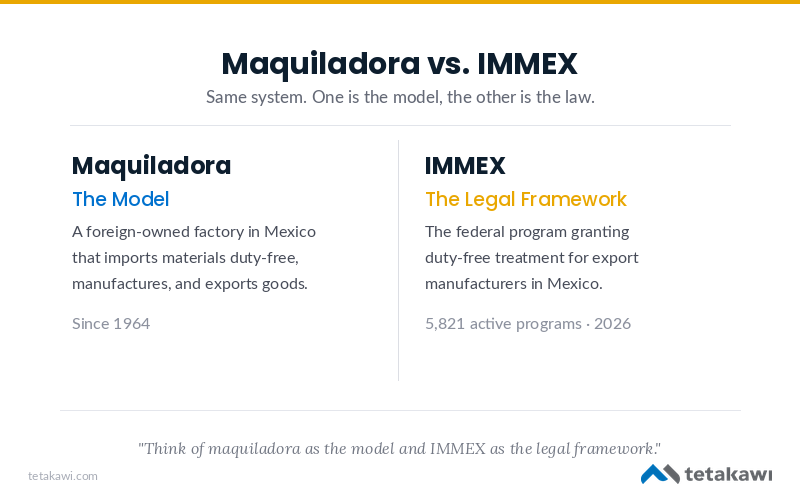
If you're researching Mexico manufacturing, you'll see two terms used almost interchangeably: "maquiladora" and "IMMEX." They're related but not the same thing. Maquiladora describes what you're doing: manufacturing in Mexico for export using duty-free imported materials. IMMEX is how you're legally allowed to do it: the federal program that grants the duty-free treatment. The maquiladora concept has existed since 1964. IMMEX, the modern legal framework, was created in 2006. You'll hear both terms constantly. Think of "maquiladora" as the model and "IMMEX" as the legal framework.
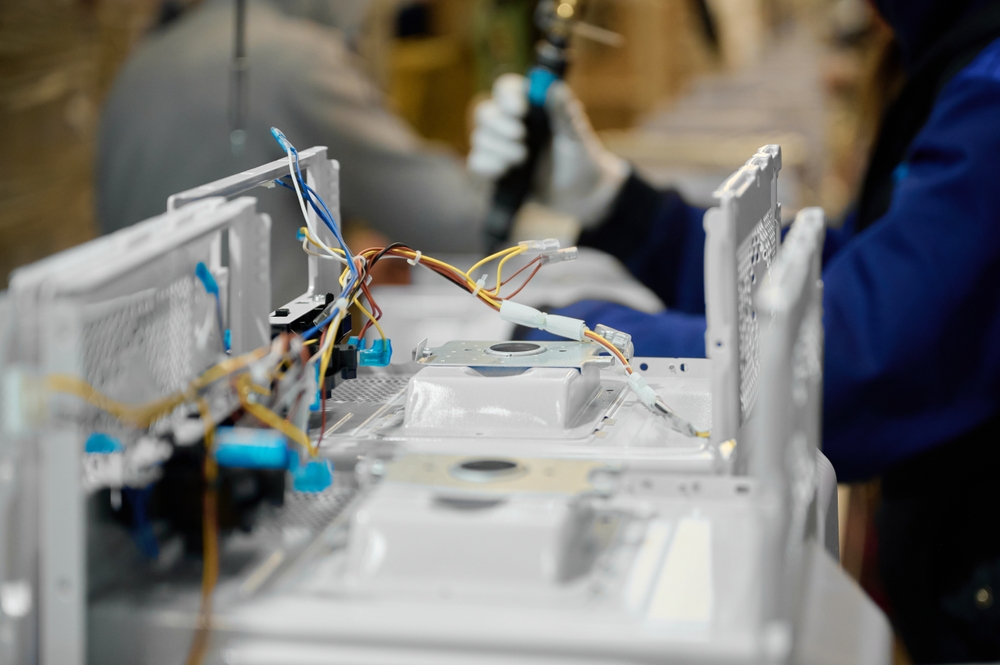
One misconception worth clearing up: maquiladoras are not just assembly plants. That was accurate in the 1960s. Today, IMMEX-registered operations produce finished goods across automotive, aerospace, medical devices, electronics, and consumer products. The sophistication of what happens inside these facilities has changed dramatically, even if the name hasn't.
How the IMMEX Program Works for Maquiladoras
If the maquiladora is the model, IMMEX is the legal framework that makes it run. IMMEX (Industria Manufacturera, Maquiladora y de Servicio de Exportación) was created in 2006 when Mexico merged the Maquiladora Decree and PITEX into a single program. The Secretaría de Economía administers it and publishes the full directory of active IMMEX programs monthly.
IMMEX registration lets you temporarily import raw materials, components, machinery, and equipment without paying Mexico's general import duties. To qualify, your company must export at least $500,000 annually or export at least 10% of total sales.
IMMEX alone does not cover the 16% value-added tax (IVA). That requires a separate step: the Certificación IVA/IEPS (commonly called CIVA). With CIVA in place, you receive a tax credit on the IVA for temporary imports instead of paying it upfront and waiting for reimbursement. Most operating maquiladoras hold both IMMEX and CIVA. Additional certifications like PROSEC (reduced tariffs on specific inputs) and OEA (Mexico's trusted trader program, similar to C-TPAT) layer on further benefits depending on your industry and trade lanes. For a deeper look at how IMMEX works operationally, see our full guide.
The Five IMMEX Modalities
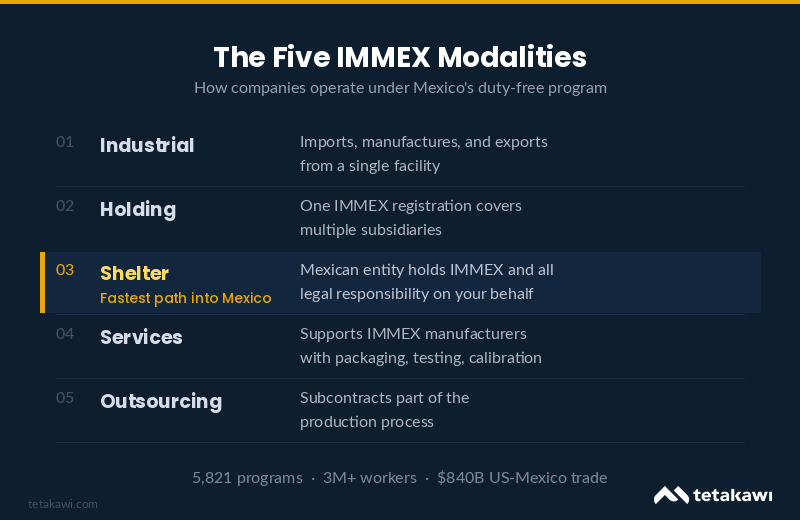
IMMEX is not one-size-fits-all. The program operates under five modalities, each designed for a different operating structure. The one you choose determines who holds the registration, who assumes compliance responsibility, and how your supply chain is organized.
| Modality | Who It's For |
|---|---|
| Industrial | The standard. One company, one facility, one IMMEX registration. You import materials, manufacture goods, and export them. This is the most common modality. |
| Holding Company | A parent entity holds one IMMEX registration covering multiple subsidiaries. Useful if you operate several plants in Mexico and want consolidated compliance. |
| Shelter | A Mexican entity holds the IMMEX and assumes all legal, fiscal, and regulatory responsibility. You control production; the partner handles everything else. The fastest path for manufacturers entering Mexico for the first time. See our guide to shelter services. |
| Services | For companies that support IMMEX manufacturers (packaging, testing, calibration) rather than manufacturing goods themselves. |
| Outsourcing | Lets an IMMEX holder subcontract part of its production process to a third party while maintaining program compliance. |
One thing to plan for: the regulatory environment around IMMEX has tightened. In 2025, the Secretaría de Economía suspended more than 600 IMMEX programs for compliance failures. Lose your registration, lose your duty-free import privileges. Whether you hold your own IMMEX or operate under a shelter provider's, compliance infrastructure needs to be in place from day one.
Shelter Model (Faster Entry)
- 30-day launch timeline
- IMMEX + CIVA already in place
- Access to existing facilities
- Managed compliance (partner handles)
- Best for manufacturers new to Mexico
Standalone Entity (Full Control)
- 6-12 month setup timeline
- Own IMMEX + CIVA registration required
- Build or lease dedicated facilities
- Self-managed compliance
- Best for larger, established operations
Maquiladoras by the Numbers
Before you evaluate whether the maquiladora model makes sense for your operation, it helps to understand the scale of what already exists. This is not an experimental program. It is the backbone of North American manufacturing.
| Metric | Figure | Source |
|---|---|---|
| Active IMMEX programs | 5,821 | SNICE / Secretaría de Economía (Feb 2026) |
| Total IMMEX employment | 3+ million workers | INEGI |
| Mexico total exports (2024) | $617 billion | INEGI |
| Manufactured goods as % of exports | ~90% | INEGI |
| US-Mexico goods trade (2024) | $840 billion (record) | US Census Bureau |
| FDI into Mexico (Jan–Sep 2025) | $40.9 billion | Secretaría de Economía |
| Manufacturing share of Mexico GDP | ~20% | World Bank |
| Operational launch timeline (shelter model) | 30 days | Industry operational data |
Mexico became the United States' largest trading partner in 2023 and held that position through 2024. The maquiladora model, operating through IMMEX, is the infrastructure that makes this volume of cross-border manufacturing possible.
Where Are Maquiladoras Located in Mexico?
Historically, the answer was simple: right on the US-Mexico border. Baja California still leads with nearly 18% of all active IMMEX programs, followed by Nuevo León at close to 15% and Chihuahua at about 8%. The twin-city corridors — Tijuana/San Diego, Juárez/El Paso, Nuevo Laredo/Laredo, Reynosa/McAllen — built their manufacturing density over decades. The Laredo crossing alone handled $339 billion in two-way trade in 2024, according to the Bureau of Transportation Statistics. Logistics from the border are hard to beat.
What the concentration data doesn't show is the trade-off. Decades of manufacturing density in border cities have driven up wages, tightened the labor market, and reduced available industrial real estate. Workforce turnover in border corridors runs higher than interior locations because workers have dozens of employers competing for them within a short commute.
Corridors 4 to 5 hours from the border present a different equation. Cities like Saltillo, Hermosillo, and Mazatlán have lower wage floors, available real estate, and lower turnover. Logistics still work: Saltillo connects to Laredo in under 4 hours. Hermosillo is about 3.5 hours from the Nogales crossing into Arizona. Mazatlán has a deep-water port and growing rail and highway infrastructure connecting north. The Bajío region (Guanajuato, Querétaro, Aguascalientes, San Luis Potosí, Jalisco) has attracted significant automotive and aerospace investment over the past decade, proving that manufacturing in Mexico no longer requires a border address.
For manufacturers not yet in Mexico, this is worth understanding: the border corridors are established, but the cost advantages that drew companies there in the 1980s have compressed. Interior locations still have that margin.
What Industries Use Maquiladoras?
Automotive is the dominant sector by a wide margin. Mexico exported $168 billion in vehicles alone in 2024, with the broader automotive sector (including parts classified under machinery and electronics categories) exceeding $190 billion per INEGI. Machinery including computers followed at $130 billion, and electrical and electronic equipment at $114 billion.
Medical, optical, and technical instruments account for $37 billion in exports, with medical devices as one of the fastest-growing subsegments. Mexico has become a global hub for medical manufacturing, particularly in the Baja California and Chihuahua corridors.
Aerospace, plastics, furniture, appliances, and consumer goods round out the mix. Companies operating maquiladoras range from multinationals like Ford, General Electric, and Samsung to mid-market manufacturers running a single line. If your product requires labor-intensive manufacturing, benefits from US proximity, and ships in volume, the maquiladora model is likely already common in your industry.
The shift over the past two decades has been from low-complexity assembly to high-value manufacturing. Mexico's maquiladoras now produce jet engine components, surgical instruments, and semiconductor packaging. If you're still picturing a 1960s border assembly plant, the reality will surprise you.
Mexico Export Value by Sector (2024)
Source: INEGI Trade Map Data, 2024
Benefits of Operating a Maquiladora in Mexico
If you're building a business case for Mexico, these are the numbers your CFO will want to see. Manufacturing labor in Mexico runs approximately 60% lower than equivalent positions in the United States, with the differential widening for skilled trades that are increasingly scarce in US labor markets. That scarcity is structural: Deloitte and the Manufacturing Institute project the US will face 2.1 million unfilled manufacturing jobs by 2030. Mexico's stable demographics and deep manufacturing workforce provide a labor pool that the US market simply does not have.
There's also a resiliency argument. Companies with production concentrated in a single country learned the cost of that during COVID and subsequent supply chain disruptions. A Mexico operation gives you a second production base inside the USMCA zone, close enough to manage directly while diversifying your exposure.
Trade access extends well beyond the US border. Mexico has 14 free trade agreements covering 52 countries, including the EU, Japan, and most of Latin America. Products manufactured in Mexico and exported under these agreements receive preferential tariff treatment.
Under the USMCA, goods that meet rules of origin requirements qualify for duty-free treatment between Mexico, the US, and Canada. Non-qualifying goods currently face a 10–15% Section 122 surcharge (imposed after the US Supreme Court struck down the previous 25% IEEPA tariffs in February 2026). The Section 122 authority expires after 150 days, roughly late July 2026, the same window as the USMCA joint review. Tariff policy is actively shifting, which makes USMCA qualification more important now than at any point since the agreement took effect. For a detailed analysis, see our breakdown of the USMCA 2026 review.
Speed matters, and the gap between entry models is significant. Under a shelter arrangement, a manufacturer can be operational in Mexico within 30 days because the shelter provider already holds the IMMEX registration, has existing facilities, and manages workforce recruitment. A standalone entity setup, where you establish your own Mexican legal entity and obtain your own IMMEX registration, typically takes 6 to 12 months. For manufacturers under competitive pressure to move production quickly, that difference often determines which model they choose.
How the Maquiladora Model Has Evolved
The maquiladora program launched in 1964 as the Border Industrialization Program, designed to create jobs along Mexico's northern border after the Bracero Program ended. Early operations were simple: import components, assemble them, export the finished product.
NAFTA in 1994 opened the floodgates. Foreign direct investment surged, and the maquiladora model expanded beyond the border zone. The 2006 IMMEX consolidation modernized the regulatory framework. USMCA in 2020 tightened rules of origin, particularly for automotive (75% regional value content requirement).
For the full history of how the maquiladora model evolved from 1964 to today, including the impact of NAFTA, IMMEX reform, and the nearshoring wave, see our detailed timeline.
The most consequential shift is structural. In the traditional model, a manufacturer entering Mexico coordinated five or more separate vendors: a landlord for industrial space, a staffing agency for labor, a customs broker for imports and exports, a logistics provider for freight, and legal counsel for compliance. Each vendor operated independently. The manufacturer managed the gaps between them.
The Manufacturing Campus model consolidates these functions under a single operational platform. Industrial space, workforce management, logistics, and compliance operate as an integrated system rather than a collection of vendor relationships. This is a structural change in how foreign manufacturers operate in Mexico, not a branding exercise.
Are Maquiladoras Good for Mexico?
This question comes up frequently, and the data answers it clearly. The maquiladora program was created in 1964 specifically to generate employment along Mexico's northern border, and by that measure it has delivered: more than 3 million direct jobs today, with millions more in supporting industries. IMMEX-registered operations account for roughly 65% of Mexico's total exports.
The program's early decades drew criticism for low wages and poor working conditions. That has changed materially. Mexico's federal minimum wage has increased more than 110% since 2018. The USMCA introduced enforceable labor protections that did not exist under NAFTA, including the right to collective bargaining, secret ballot union votes, and a Rapid Response Labor Mechanism that allows the US to investigate specific facilities. These are not theoretical provisions. As of early 2026, the US has filed more than 30 cases under the mechanism.
For manufacturers evaluating Mexico, the labor compliance environment is now part of the operating equation. Companies that treat compliance as a cost center rather than an operational requirement expose themselves to USMCA enforcement actions, IMMEX suspensions, and reputational risk. This is another area where the operating model you choose matters: a shelter partner with established compliance infrastructure handles labor law, social security, and safety regulations as part of the service.
What This Means for Manufacturers
If you're evaluating Mexico for manufacturing operations in 2026, three things have changed that affect how you approach the maquiladora model:
IMMEX compliance is non-negotiable. The Secretaría de Economía suspended 600+ programs in 2025. If your IMMEX registration is revoked, you lose duty-free import privileges overnight. Whether you hold your own registration or operate under a shelter provider's registration, compliance infrastructure has to be in place from day one.
USMCA qualification determines your effective tariff rate. Qualifying goods enter the US duty-free. Non-qualifying goods face a 10–15% Section 122 surcharge, and that rate could change again when the 150-day authority expires in late July, the same week as the USMCA joint review. Manufacturers should be mapping their product lines against USMCA rules of origin now, not after the review.
The operating model you choose matters more than the location you pick. Shelter vs. standalone entity is not just a legal decision. It determines your compliance structure, your launch timeline, your overhead, and your exposure to regulatory risk. A manufacturer with the wrong operating structure in the right city will underperform a manufacturer with the right structure anywhere.
The Bottom Line
The maquiladora model that started as a border-zone assembly incentive in 1964 now underpins an $840 billion trading relationship between the US and Mexico. The model works. Nearly 6,000 active IMMEX programs and more than 3 million workers confirm that. The question for manufacturers in 2026 is not whether to use the model, but how: which IMMEX modality fits your operation, whether shelter or standalone gives you the right compliance infrastructure, and how to build an operation that qualifies under USMCA before the July review reshapes the rules.
If you're ready to go deeper, here's a logical path:
- Understand shelter vs. standalone. Our guide to shelter services in Mexico compares the two operating models side by side.
- Get the full cost picture. The cost of manufacturing in Mexico guide covers labor rates by region, shelter vs. standalone economics, and total landed cost.
- Assess your tariff exposure. Our USMCA 2026 review analysis breaks down what the July review means for your product lines.
Frequently Asked Questions About Maquiladoras
What is a maquiladora in simple terms?
A maquiladora is a foreign-owned factory in Mexico that imports raw materials without paying duties, manufactures products, and exports them. Most maquiladoras operate under Mexico's IMMEX program, which provides the legal framework for duty-free imports. As of February 2026, 5,821 active IMMEX programs are registered with Mexico's Secretaría de Economía.
What is the difference between a maquiladora and a regular factory?
A maquiladora operates under Mexico's IMMEX program, which allows duty-free temporary import of raw materials and components for export manufacturing. A regular factory in Mexico pays standard import duties on materials. Most maquiladoras are foreign-owned and export-oriented, while regular factories may produce primarily for the domestic market.
How does the IMMEX program work for maquiladoras?
IMMEX allows registered companies to temporarily import raw materials, components, and equipment without paying import duties. A separate certification (Certificación IVA/IEPS, or CIVA) provides a tax credit on the 16% value-added tax so you don't pay it upfront on temporary imports. Most maquiladoras hold both. Companies must export at least $500,000 annually or 10% of total sales to qualify. The program operates under five modalities: Industrial, Holding Company, Shelter, Services, and Outsourcing. The Shelter modality is the most common entry point for first-time manufacturers in Mexico.
What industries operate maquiladoras in Mexico?
Automotive is the largest sector, with vehicles alone accounting for $168 billion in exports (2024) and the broader automotive sector exceeding $190 billion. Machinery including computers followed at $130 billion, and electrical and electronic equipment at $114 billion. Medical devices are one of the fastest-growing subsegments. Aerospace, plastics, furniture, appliances, and consumer goods are also well-represented. All export figures from ITC Trade Map / UN COMTRADE 2024 data.
Where are maquiladoras located in Mexico?
The majority are in Mexico's northern border states, with Baja California leading at nearly 18% of all active IMMEX programs. Key border corridors include Tijuana/San Diego, Ciudad Juárez/El Paso, and Nuevo Laredo/Laredo. However, border cities face increasing wage pressure and workforce turnover due to decades of saturation. Interior corridors 4 to 5 hours from the border (Saltillo, Hermosillo, Mazatlán) offer lower wages, available real estate, and lower turnover, with strong logistics connections to the US. The Bajío region (Guanajuato, Querétaro, Jalisco) has also grown significantly for automotive and aerospace.
How has the maquiladora model changed since NAFTA?
Three major shifts define the evolution. First, the 2006 IMMEX consolidation replaced the separate Maquiladora Decree and PITEX programs with a single modern framework. Second, USMCA (2020) tightened rules of origin, requiring higher regional value content for duty-free treatment. Third, the post-COVID nearshoring wave made Mexico the US's largest trading partner, bringing record FDI and IMMEX registrations. The operational model has shifted too: many manufacturers now operate within integrated campus environments rather than coordinating multiple independent vendors.
Are maquiladoras good for Mexico?
Yes. The program generates over 3 million direct jobs and accounts for roughly 65% of Mexico's total exports. Early criticism about low wages has been addressed by a 110%+ increase in the federal minimum wage since 2018 and enforceable USMCA labor protections including collective bargaining rights, secret ballot union votes, and a Rapid Response Labor Mechanism. Companies operating under IMMEX are subject to these standards, and non-compliance carries real consequences: the US has filed more than 30 cases under the mechanism as of early 2026.
Thinking about manufacturing in Mexico? Download this ebook and start moving your due diligence forward.