KEY TAKEAWAY
Mexico produced 3.95 million vehicles in 2025, ranking as the world's fifth-largest vehicle manufacturer. Thirteen global automakers operate assembly plants across 11 Mexican states, supported by a $119 billion auto parts industry that exports 87.9% of its output to the United States. For Tier 2 and Tier 3 auto parts suppliers, the USMCA's 75% regional value content requirement and ongoing supply chain localization are creating measurable opportunities to serve OEMs already manufacturing in Mexico.
Thirteen car brands are currently made in Mexico: Audi, BMW, Ford, General Motors, Honda, KIA, Mazda, Nissan, Stellantis (Jeep, Ram, Chrysler), Toyota, and Volkswagen, plus Chinese-affiliated manufacturers Foton and Giant Motors/JAC. Together, they produced 3.95 million vehicles in 2025, making Mexico the world's fifth-largest vehicle manufacturer.
Those 3.95 million vehicles were assembled across 11 states, from Baja California to Puebla. Of the 3.39 million exported, the vast majority crossed the U.S. border. Behind every finished vehicle sits a $119 billion auto parts supply chain — one that ships 87.9% of its output north.
This guide covers every car brand currently manufacturing in Mexico, maps the OEM assembly landscape state by state, and explains what this concentration of automotive manufacturing in Mexico means for parts suppliers evaluating their own expansion.
How Many Cars Does Mexico Produce?
3.95M
Vehicles Produced (2025)
5th
Global Producer (OICA)
$119B
Auto Parts Production
87.9%
Parts Exports to the U.S.
Mexico surpassed Germany and South Korea in 2024 to reach that fifth-place ranking, according to the International Organisation of Motor Vehicle Manufacturers (OICA). Output dipped 0.9% from 2024's record, but the export figure — 3.39 million vehicles, overwhelmingly bound for the United States — held steady.
General Motors led production with 857,431 vehicles, though that figure represented a 3.6% annual decrease. Toyota was the growth story, surging 26.6% to 310,152 units. Ford and KIA also posted gains of 7.9% and 6.4%, respectively. Mexico's EV production reached 198,678 units in 2025, a milestone driven primarily by Ford's Mustang Mach-E assembly in Estado de México and GM's electric vehicle investments at Ramos Arizpe.
The auto parts industry generated $119 billion in total production in 2025, with $103.5 billion in exports. Of those exports, 87.9% by value went to the United States, according to data from INEGI and the Mexican Automotive Industry Association (AMIA).
Which Car Brands Are Made in Mexico?
Thirteen automakers currently operate vehicle assembly plants in Mexico. The table below summarizes every brand, their locations, key models, and recent investments as of March 2026.
| Brand | Location(s) | Key Models | Status |
|---|---|---|---|
| Audi | San José Chiapa, Puebla | Q5 | Operational |
| BMW | San Luis Potosí | 3 Series, 2 Series Coupe, M2 | Operational + EV expansion |
| Ford | Hermosillo, Cuautitlán, Irapuato | Bronco Sport, Maverick, Mustang Mach-E | Operational |
| General Motors | Silao, Ramos Arizpe, SLP, Toluca | Silverado, Equinox, Blazer EV | Operational (857K units, 2025) |
| Honda | Celaya, Guanajuato | HR-V | Suspended (chip shortage) |
| KIA | Pesquería, Nuevo León | K3, K4, Rio, Seltos | Operational + $150M expansion |
| Mazda | Salamanca, Guanajuato | Mazda2, Mazda3, CX-30 | Operational (2M milestone) |
| Nissan | Aguascalientes A1/A2, CIVAC | Versa, Sentra, Kicks | Operational (restructuring) |
| Stellantis | Saltillo, Toluca, Chihuahua | Ram 1500, Jeep Cherokee Hybrid, EV Wagoneer S | Operational + new models 2026 |
| Toyota | Tijuana, Apaseo el Grande | Tacoma | Operational (+26.6% growth) |
| Volkswagen | Puebla, Silao (engines) | Jetta, Taos, Tiguan | Operational since 1965 |
| Foton | Tlajomulco, Jalisco | Tunland pickup | Opening Q1-Q2 2026 |
| Giant Motors / JAC | Sahagún, Hidalgo | JAC commercial & passenger | Operational + expansion |
Audi
Audi opened its San José Chiapa plant in Puebla in 2016, making it the only facility in the world that produces the Audi Q5. The plant has an annual production capacity exceeding 124,000 units, and the vast majority of its output is exported to the United States and Europe. Audi's investment in Puebla totals approximately $1.3 billion, and the plant employs around 5,200 workers.
BMW
BMW's San Luis Potosí plant has been operational since 2019, producing the 3 Series, 2 Series Coupe, and M2 with an annual capacity of 175,000 vehicles. In 2026, BMW began construction on a battery assembly facility at the same site. From 2027, the plant will produce the Neue Klasse electric crossover, representing an 800-million-euro total investment in the facility. The plant employs approximately 3,700 workers.
Ford
Ford operates three facilities in Mexico. The Hermosillo Stamping and Assembly Plant in Sonora produces the Bronco Sport and Maverick, with a capacity of 300,000 units per year. The plant recently hit its 7-millionth unit milestone. Ford's Cuautitlán Stamping and Assembly Plant in Estado de México builds the all-electric Mustang Mach-E, having surpassed 150,000 units produced. In Irapuato, Guanajuato, Ford's EV powertrain center produces electric motors and transaxles with an annual capacity of 260,000 units.
General Motors
General Motors is the largest vehicle producer in Mexico, manufacturing 857,431 vehicles in 2025 across four assembly plants. The Silao Complex in Guanajuato produces full-size pickups including the Silverado. Ramos Arizpe in Coahuila is transitioning toward EV production with a GM-Honda joint venture. San Luis Potosí and Toluca round out the footprint. GM's cumulative investment in Mexico exceeds $14 billion over the past two decades, making it the largest automotive investor in the country.
Honda
Honda's Celaya plant in Guanajuato has an annual capacity of 200,000 vehicles and is the sole production source for the HR-V in North America. However, production has been suspended indefinitely since October 2025 due to a semiconductor shortage linked to Dutch government sanctions on Nexperia and retaliatory Chinese export restrictions. Honda has not announced a restart date, stating the "situation is constantly changing." The suspension underscores the chip supply chain vulnerabilities that continue to affect global automotive manufacturing.
KIA
KIA opened its Pesquería plant near Monterrey, Nuevo León in May 2016 with a capacity of 300,000 units per year. The plant surpassed two million vehicles produced and has received a $150 million expansion investment. KIA now produces the K3, K4, Rio, and Seltos at Pesquería, exporting to nearly 70 countries. Production reached 288,000 units in 2025, a 6.4% increase from the prior year.
Mazda
Mazda's Salamanca plant in Guanajuato produces the Mazda2, Mazda3, CX-3, and CX-30, and recently reached a milestone of two million vehicles assembled. The 2026 Mazda3 includes the Mild-Hybrid 24V e-Skyactiv-G system. However, output fell 43.9% in January 2026 compared to January 2025, reflecting demand softness in key export markets.
Nissan
Nissan operates two assembly complexes in Aguascalientes (A1 and A2) plus the CIVAC plant in Morelos, producing the Versa, Sentra, Kicks, and NP300 pickup. Nissan is undergoing a global restructuring, consolidating from 17 plants to 10 by fiscal year 2027 after posting a $4.5 billion net loss. The COMPAS joint venture plant with Mercedes-Benz in Aguascalientes will cease operations on May 31, 2026, eliminating 3,600 direct jobs. Chinese automakers BYD, Geely, and others are bidding to acquire the COMPAS facility.
Stellantis
Stellantis (formerly Fiat Chrysler Automobiles, or FCA, which merged into Stellantis in January 2021) operates multiple facilities in Mexico. The Saltillo Complex in Coahuila includes the South Engine Plant and the Saltillo Engine Plant, producing the Pentastar, HURRICANE twin-turbo, and HEMI V8 engines. Saltillo also produces the Ram 1500 pickup, targeting 163,000 units annually with a second-shift expansion underway. In Toluca, Estado de México, Stellantis is introducing the Jeep Cherokee Hybrid, the all-electric Jeep Recon, and the EV Wagoneer S in 2026, marking the first Cherokee production in Mexico and a significant EV expansion for the brand.
Toyota
Toyota operates assembly in Tijuana, Baja California and at the newer Apaseo el Grande plant in Guanajuato, which produces the Tacoma pickup with a capacity of 100,000 units per year. Toyota was the standout growth performer in 2025, surging 26.6% to produce 310,152 vehicles. The company invested $1.1 billion in Guanajuato and announced an additional $328 million for hybrid-electric Tacoma production. More than 70% of Toyota's Guanajuato components are manufactured locally.
Volkswagen
Volkswagen's Puebla plant is the longest-running automotive assembly operation in Mexico, having opened in 1965. It produces the Jetta, Taos, and Tiguan with a capacity of 300,000 vehicles per year. VW also operates an engine plant in Silao, Guanajuato, producing the EA888 and EA211 engines at a rate of 2,500 per day. Puebla is being prepared for EV production, and VW is constructing its first battery plant outside Germany at the facility. The Silao engines will also supply Scout Motors in the United States.
Chinese and Emerging OEMs
Two Chinese-affiliated automakers are now producing or preparing to produce in Mexico. Giant Motors Latinoamérica assembles JAC-branded commercial and passenger vehicles at its Sahagún, Hidalgo facility, with a current capacity of 60,000 units per year and a doubling expansion underway. Foton is opening its Tlajomulco, Jalisco assembly plant in the first half of 2026, starting with the Tunland pickup at an initial capacity of 1,000 vehicles annually.
Tesla announced a Gigafactory near Monterrey, Nuevo León in 2023, but construction remains in a holding pattern. The site has permits and surrounding infrastructure work is underway, though Tesla has not committed to a production start date. Meanwhile, BYD and Geely are among finalists bidding to acquire the COMPAS plant in Aguascalientes, which would give a major Chinese EV manufacturer an instant 230,000-unit-capacity assembly footprint in North America.
Where Cars Are Made in Mexico: The OEM Assembly Map
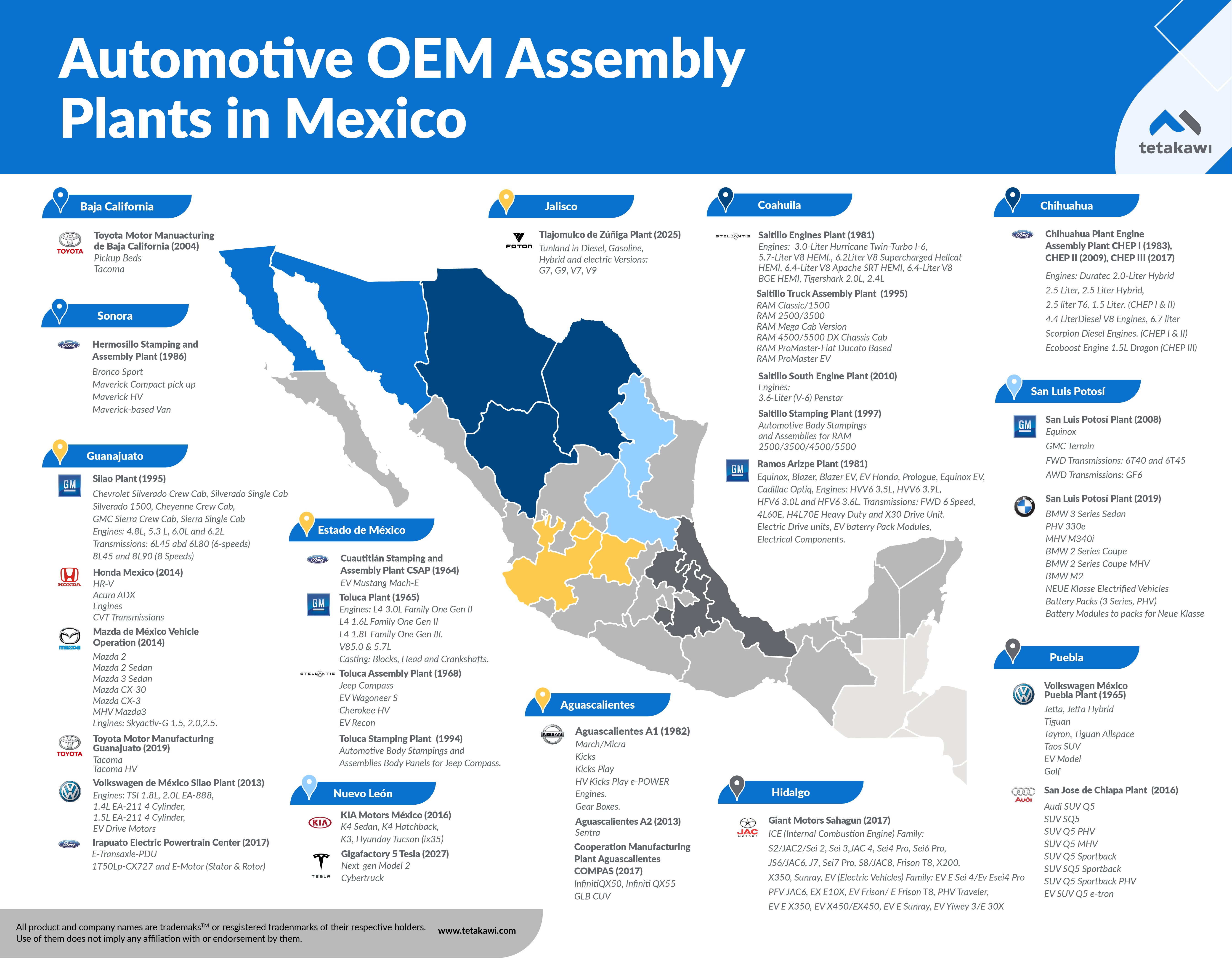
Automotive assembly in Mexico is concentrated in specific industrial corridors, each with distinct advantages for OEMs and their supplier networks. The map below shows every active OEM assembly plant by state as of March 2026.
| State | OEM(s) | Key Output |
|---|---|---|
| Guanajuato | GM, Toyota, Mazda, Honda*, Ford (powertrain), VW (engines) | Mexico's largest auto cluster. 6 facilities. |
| Coahuila | Stellantis, GM | Ram 1500, engines, EV transition at Ramos Arizpe. |
| Aguascalientes | Nissan, COMPAS (closing May 2026) | Versa, Sentra. COMPAS sale pending. |
| Puebla | VW, Audi | Jetta, Taos, Tiguan, Q5. EV preparation. |
| Estado de México | Ford, GM, Stellantis | Mustang Mach-E, Jeep Cherokee Hybrid, EV Wagoneer S. |
| Nuevo León | KIA, Tesla (planned) | KIA Pesquería 300K capacity. Tesla TBD. |
| San Luis Potosí | BMW, GM | 3 Series, M2, Neue Klasse (2027). |
| Sonora | Ford | Bronco Sport, Maverick. 300K capacity. |
| Baja California | Toyota | Tacoma assembly in Tijuana. |
| Jalisco | Foton (opening 2026) | Tunland pickup. Chinese OEM entry. |
| Hidalgo | Giant Motors / JAC | Commercial and passenger vehicles. |
*Honda Celaya suspended indefinitely since October 2025.
The Bajío region (Guanajuato, Aguascalientes, San Luis Potosí) is the densest automotive corridor, hosting more OEM assembly plants than any other zone in the country. The Guanajuato automotive cluster alone contains hundreds of Tier 1, Tier 2, and Tier 3 suppliers within a 200-kilometer radius of the major OEM plants. Northern states like Coahuila, Nuevo León, and Sonora offer a different advantage: proximity to the U.S. border and lower freight costs for export-heavy production. Mexico's Pacific coast adds another logistics layer — port cities like Mazatlán give suppliers direct access to Asian raw material imports and Pacific Rim trade routes, often at a lower operating cost structure than the saturated border and Bajío corridors. For a deeper look at how this automotive manufacturing ecosystem in Mexico operates across regions, the cluster data is where the real story lives.
FOR SUPPLY CHAIN LEADERS
If you're a Tier 2 or Tier 3 auto parts supplier evaluating Mexico, the sections below are written for you. We cover the supplier ecosystem economics, the USMCA content rules shaping OEM procurement, and a framework for evaluating whether a Mexico operation fits your business.
The Supplier Ecosystem Behind Every Vehicle Made in Mexico
Mexico's auto parts industry produced $119 billion in 2025, with $103.5 billion in exports — 87.9% of which went to the United States. The brand names get the headlines, but the real infrastructure story in Mexican automotive is the supplier ecosystem. Every vehicle assembled in Mexico contains thousands of components sourced from a tiered supply chain that extends across the country.
$103.5B
Parts Exports (2025)
1,065
U.S. Auto Parts Firms (NAICS 33639)
2.8%
Avg. U.S. Parts Maker Profit Margin
75%
USMCA Regional Content Rule
The U.S. auto parts manufacturing industry (NAICS 33639) generated $68.7 billion in revenue across 1,065 businesses in 2025, according to IBISWorld. The average firm has 128 employees and operates on a 2.8% profit margin. Major global players like Bosch (4.6% market share), Denso (4.5%), and Magna (3.8%) anchor the Tier 1 level, but the real growth pressure sits at Tier 2 and Tier 3, where smaller suppliers face annual price decrease mandates from OEM customers and increasing costs for labor, raw materials, and compliance.
This margin pressure is the primary reason auto parts suppliers evaluate Mexico. With 52.6% of U.S. parts revenue dependent on automaker demand and OEMs increasingly requiring regional sourcing to meet USMCA content rules, the question for many Tier 2 and Tier 3 suppliers is not whether to establish a Mexico presence but when.
Three product segments face particular disruption from the EV transition: exhaust systems ($14.7 billion), filters ($7.8 billion), and engine-specific components. Suppliers in these segments have an additional strategic incentive to diversify their manufacturing footprint while demand for their core products remains strong enough to fund the transition.
USMCA's 75% Rule and What It Means for This Supply Chain
One trade rule explains more about why these 13 OEMs are in Mexico than any other single factor. The USMCA requires 75% regional value content (RVC) for vehicles to qualify for duty-free treatment between the U.S., Mexico, and Canada, up from 62.5% under the original NAFTA. That threshold is now fully phased in, and the aggregate utilization rate stands at approximately 85% (Penn Wharton Budget Model, January 2026 data). For parts suppliers, this means components manufactured in Mexico count toward the content calculation, giving Mexico-based suppliers an inherent advantage in OEM procurement.
The USMCA's automotive rules of origin are under active review. On February 19, 2026, the USITC launched a comprehensive investigation into the 75% content threshold. For a detailed breakdown of what the 2026 review means for manufacturers, see our guide: The USMCA 2026 Review: What Manufacturers Actually Need to Prepare For. For the broader tariff landscape affecting manufacturers in Mexico, we cover Section 122, Section 232, and IEEPA separately.
What This Means for Parts Manufacturers Evaluating Mexico
For Tier 2 and Tier 3 auto parts suppliers, the convergence of OEM concentration, USMCA content requirements, and margin pressure creates a specific set of conditions worth evaluating:
- Customer proximity. Thirteen OEMs operate assembly plants across 11 Mexican states. For a parts supplier, manufacturing within the same automotive corridor reduces freight costs and lead times while improving responsiveness to just-in-time delivery requirements.
- USMCA compliance. Parts manufactured in Mexico count toward the 75% regional value content calculation. This makes Mexico-based suppliers more attractive to OEMs navigating content thresholds, particularly as the 2026 USITC review may tighten rules further.
- Labor cost arbitrage. At an average profit margin of 2.8%, U.S. auto parts manufacturers have limited room to absorb annual price decrease mandates from OEM customers. Mexico's competitive labor costs offer a structural advantage without sacrificing proximity to North American end markets.
- EV transition hedge. Suppliers producing exhaust systems, filters, or internal combustion engine components face $22.5 billion in threatened product segments. Establishing a Mexico operation while current demand funds the investment allows for diversification into EV-compatible product lines.
The trends driving automotive manufacturing in Mexico are structural, not cyclical. Trade policy, OEM investment patterns, and the EV transition all point in the same direction. The supplier infrastructure is already built around 13 OEM operations across 11 states — the window is whether to enter while current ICE demand funds the investment or wait until the transition is already underway. For suppliers beginning that evaluation, our nearshoring decision guide covers the full framework.
Considering a Mexico Operation to Serve These OEMs?
Tetakawi helps Tier 1, Tier 2, and Tier 3 suppliers launch and operate manufacturing in Mexico through shelter services, staffing, and ready-to-go manufacturing campuses in key automotive corridors like Saltillo and Sonora. If you're evaluating how to meet OEM demand from inside the supply chain, we can help you understand what's involved.
Talk to Our Team About Your Mexico ExpansionFrequently Asked Questions
How many cars does Mexico produce per year?
Mexico produced 3.95 million vehicles in 2025, making it the world's fifth-largest vehicle manufacturer according to OICA. The country exported 3.39 million of those vehicles, with the United States as the primary destination.
Which automaker produces the most cars in Mexico?
General Motors is the largest vehicle producer in Mexico, manufacturing 857,431 vehicles in 2025 across four assembly plants. Toyota posted the strongest growth at 26.6%, producing 310,152 vehicles in 2025.
Are electric vehicles made in Mexico?
Yes. Mexico produced 198,678 electric vehicles in 2025. Ford assembles the Mustang Mach-E at its Cuautitlán plant in Estado de México. GM is transitioning its Ramos Arizpe plant toward EV production. BMW is adding Neue Klasse electric crossover production at San Luis Potosí starting in 2027, and Stellantis is launching the all-electric Jeep Recon at Toluca in 2026.
What is the USMCA 75% rule for automotive?
The USMCA requires 75% regional value content for vehicles to qualify for duty-free treatment between the United States, Mexico, and Canada, up from 62.5% under the original NAFTA. The aggregate utilization rate stands at approximately 85%. Components manufactured in Mexico count toward the content calculation, giving Mexico-based suppliers an inherent advantage in OEM procurement decisions.
Why are auto parts suppliers moving manufacturing to Mexico?
Auto parts suppliers move to Mexico for a combination of customer proximity to 13 OEM assembly operations, competitive labor costs that help offset a 2.8% average industry profit margin, USMCA compliance advantages that make their products more attractive for OEM sourcing, and strategic positioning ahead of the EV transition that threatens $22.5 billion in combustion-engine-specific product segments.
Is Tesla building a factory in Mexico?
Tesla announced plans for a Gigafactory near Monterrey, Nuevo León in 2023. The project has the necessary permits and surrounding infrastructure work is underway, but major construction has been repeatedly delayed. As of March 2026, Tesla has not committed to a production start date for the facility.
This article was last updated on March 30, 2026. Automotive production data is sourced from AMIA and INEGI. Trade policy information, including USMCA utilization rates and tariff data, changes frequently. Manufacturers making investment decisions should consult with a licensed customs broker or trade attorney for current compliance requirements.
Thinking about manufacturing in Mexico? Download this ebook and start moving your due diligence forward.